AI Search Optimization Agencies for SaaS: GEO, LLM Visibility, and AI Overviews
AI search optimization is becoming a new shortlist criterion for SaaS companies choosing an SEO or content partner.
The old question was simple: "Can this agency help us rank on Google?" The new question is broader: "Can this agency help our brand become a trusted source across Google AI Overviews, ChatGPT, Perplexity, Gemini, comparison pages, review ecosystems, and answer-style content?"
That does not mean classic SEO is dead. Google says its best practices for SEO still apply to AI features in Search, including crawlability, helpful content, internal links, page experience, textual content, and structured data that matches visible page content. But AI search changes the buyer journey. SaaS buyers now ask longer questions, compare vendors inside AI tools, and expect summarized answers before they ever click through to a website.
This list compares AI search optimization agencies for SaaS by the kind of AI visibility problem they are best suited to solve: GEO strategy, LLM-friendly content, technical accessibility, entity authority, digital PR, and pipeline measurement.
Quick Answer
The best AI search optimization agency for SaaS depends on what you mean by AI visibility:
- Rock The Rankings: Best for SaaS teams that want explicit GEO built into SEO-focused content strategy.
- Konstruct Digital: Best for B2B SaaS companies that need GEO, SEO, PPC, content, ABM, and programmatic demand support for long sales cycles.
- SimpleTiger: Best for SaaS teams that want AI-powered content discovery, SEO, paid amplification, and CRO under one growth model.
- Skale: Best for SaaS companies that need a strong organic search foundation before investing heavily in AI search visibility.
- Growfusely: Best for SaaS content, SEO, link building, and digital PR that can support entity authority across search and AI answers.
- TripleDart: Best for growth-stage SaaS teams that want content authority, demand generation, ABM, and analytics connected to AI-era discovery.
- Powered by Search: Best for B2B SaaS teams that need AI search work tied to demand generation, RevOps, SEO, PPC, and nurture.
- Directive Consulting: Best for larger SaaS and tech companies that need SEO, content, paid media, RevOps, and pipeline reporting in one program.
- Saffron Edge: Best for SaaS companies that need full-funnel SEO, ABM, marketing automation, and revenue-focused organic growth.
If you need a pure GEO or AI search test, start with Rock The Rankings or Konstruct Digital because both profiles explicitly mention GEO. If you need the foundations that make LLM visibility possible, compare Skale, Growfusely, SimpleTiger, TripleDart, Powered by Search, Directive, and Saffron Edge.
One note: Aimers is not an SEO or GEO agency. It can still be useful as a complementary PPC, landing page, CRO, and attribution partner after SEO/GEO work starts creating demand.
Browse the full SaaS SEO agencies category for more options.
What Counts as AI Search Optimization for SaaS?
AI search optimization is the practice of making a SaaS brand easier to discover, understand, cite, and recommend in AI-assisted search environments.
That includes:
- GEO: Generative engine optimization for AI-generated answers and citations.
- LLM visibility: Brand presence in tools such as ChatGPT, Perplexity, Gemini, Claude, and Copilot-style interfaces.
- AI Overviews readiness: Eligibility and usefulness for Google's AI features in Search.
- Entity SEO: Clear brand, product, category, feature, use case, and competitor relationships.
- Structured content: Pages that answer specific buyer questions in a clear, extractable format.
- Source credibility: Third-party mentions, reviews, comparison pages, case studies, expert quotes, and consistent information across the web.
- Technical accessibility: Crawlable pages, indexable text, clean internal links, structured data, and sensible robots.txt decisions.
Google's official guidance is especially important here: there is no special schema or machine-readable file required to appear in Google AI Overviews or AI Mode. The page must be indexable, eligible to show in Google Search with a snippet, and built on strong SEO fundamentals. That is why the best AI search optimization agencies for SaaS still need real SEO depth.
For ChatGPT search visibility, OpenAI separates search crawling from model training: OAI-SearchBot is used for surfacing websites in ChatGPT search features, while GPTBot relates to training foundation models. Perplexity also publishes crawler guidance and recommends allowing PerplexityBot if a site wants to appear in Perplexity search results.
In other words, AI search optimization is not magic. It is a sharper version of search strategy, technical SEO, content architecture, entity consistency, and authority building.
Comparison Table
| Agency | Best AI-search fit | Strongest visible signal | Best for |
|---|---|---|---|
| Rock The Rankings | GEO-focused SaaS content engine | Directory profile explicitly lists Generative Engine Optimization | B2B SaaS teams that want GEO built into content strategy |
| Konstruct Digital | GEO for long-sales-cycle B2B | Directory profile lists GEO for ChatGPT, Perplexity, Gemini, and AI search engines | Technical B2B SaaS, industrial SaaS, enterprise buyers |
| SimpleTiger | AI-powered organic growth system | Profile lists AI-powered content discovery and AI-enhanced content strategy | SaaS teams that want SEO, content, paid, and CRO together |
| Skale | SEO foundation for AI visibility | Technical SEO, strategic content, programmatic pages, link building | SaaS companies that need strong organic authority first |
| Growfusely | Content authority and digital PR | Content strategy, technical SEO, link building, digital PR, creative assets | SaaS brands that need better source depth and authority |
| TripleDart | Demand-gen content authority | Content, ABM, analytics, organic and paid campaigns | Growth-stage SaaS teams that need AI visibility tied to pipeline |
| Powered by Search | Full-funnel demand generation | SEO, PPC, content, RevOps, nurture, website conversion | B2B SaaS teams that need discovery-to-pipeline alignment |
| Directive Consulting | Enterprise SEO and RevOps | SEO, content, paid media, CRO, revenue operations | Larger SaaS teams that need AI-era search tied to revenue |
| Saffron Edge | Full-funnel SEO and automation | SEO, ABM, marketing automation, lead nurturing, conversion-centric web design | SaaS teams that need organic visibility connected to nurture and lead generation |
Use this table as a shortlist filter, not a final ranking. Some agencies are better described as direct GEO partners. Others are better foundations for AI visibility because they improve the content, authority, and measurement systems that AI search engines depend on.
1. Rock The Rankings
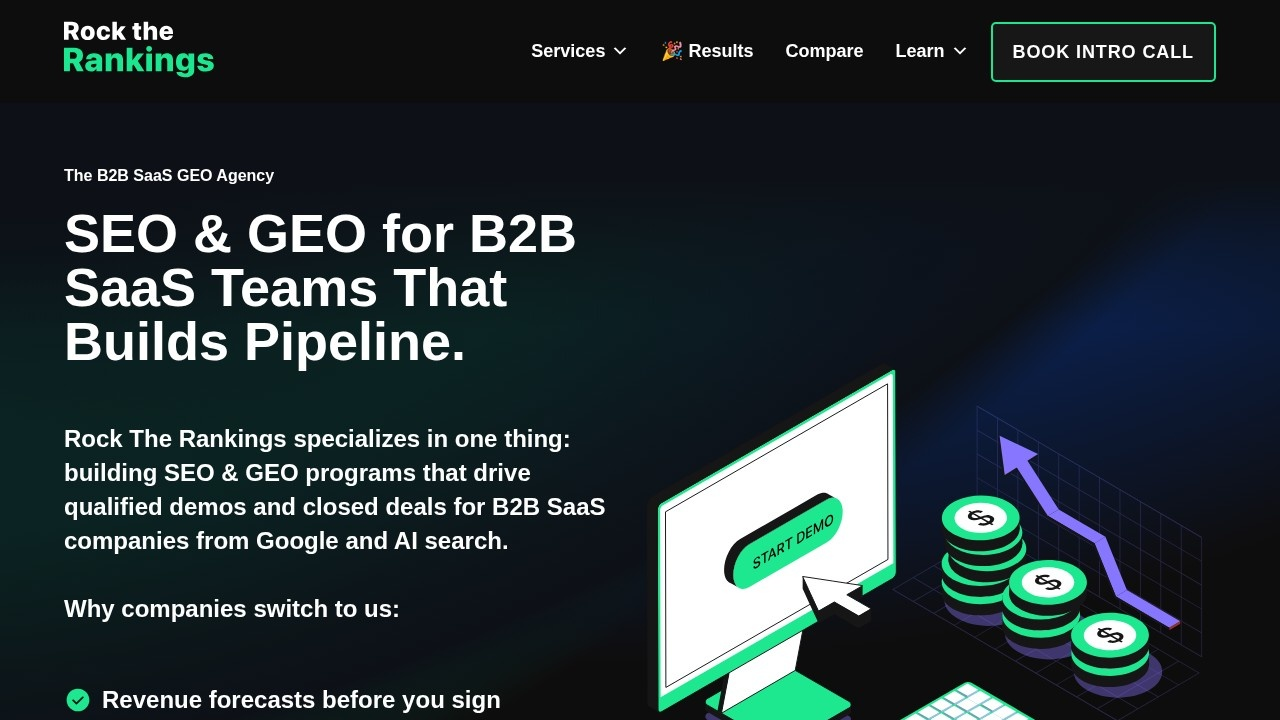
Best for: B2B SaaS teams that want explicit GEO inside an SEO content engine.
Rock The Rankings is the clearest GEO-first fit in the current SaaSAgency.org directory. Its profile describes a B2B SaaS SEO and content marketing agency focused on pipeline growth, SEO-focused content, link building, digital PR, and Generative Engine Optimization.
That matters because many agencies now talk about AI search, but fewer show a direct GEO service signal. Rock The Rankings is positioned for SaaS companies that still need the fundamentals of SEO content but want that work built for AI-era discovery from the start.
Where It Fits Best
Rock The Rankings is a strong fit when a SaaS team wants to:
- Build BOFU and MOFU content that can be cited or summarized by AI systems.
- Improve comparison-page coverage.
- Strengthen entity authority around use cases, competitors, features, and verticals.
- Connect content performance to demos, SQLs, trials, and ARR.
- Run a defined 90-day proof period before a longer SEO commitment.
What to Ask
Ask how the agency measures GEO progress. The answer should go beyond rankings. A useful GEO test should track brand mentions in AI answers, citation frequency, inclusion in comparison prompts, source accuracy, assisted conversions, and pipeline from AI-search landing pages.
2. Konstruct Digital
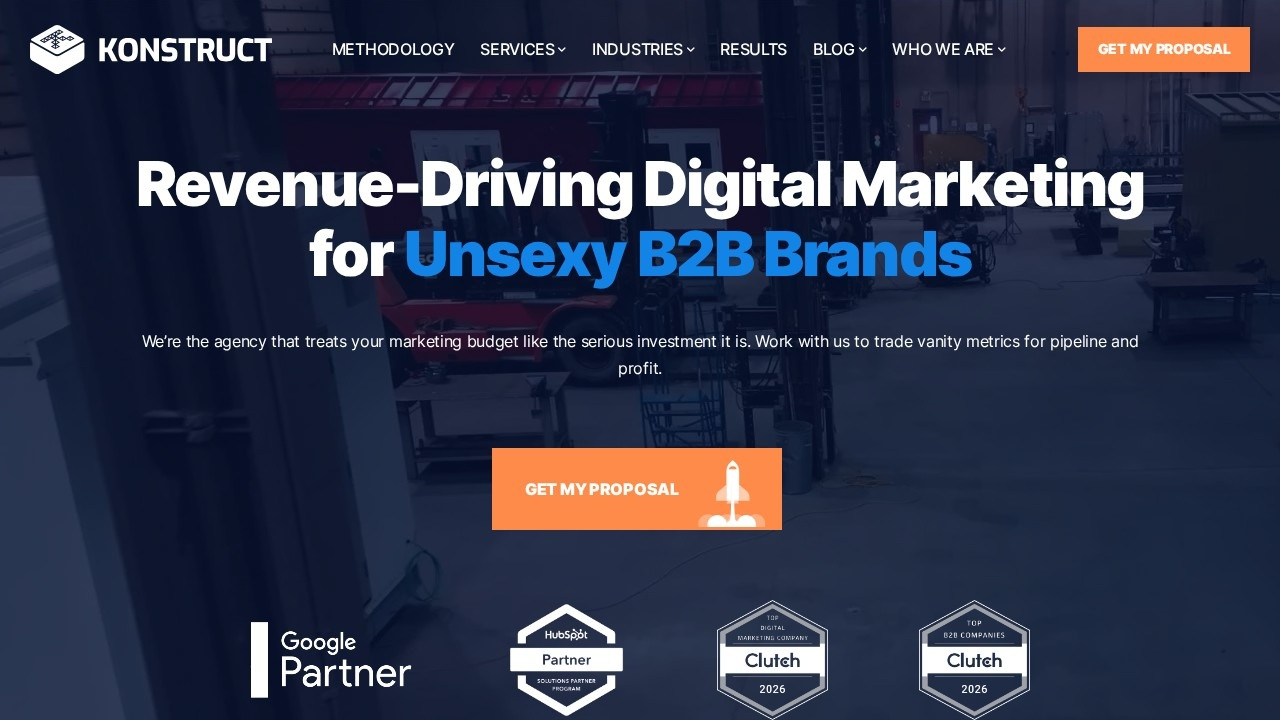
Best for: B2B SaaS companies with technical products, long sales cycles, and a need for GEO plus full-funnel demand generation.
Konstruct Digital is another direct AI-search fit. Its profile lists GEO for visibility in ChatGPT, Perplexity, Gemini, and other AI search engines, alongside SEO, PPC, content marketing, website development, ABM, and programmatic advertising.
This makes Konstruct especially relevant for B2B SaaS companies where AI search visibility cannot be handled as a content-only project. Technical buyers often ask complex, multi-step questions. They compare categories, integrations, compliance needs, alternatives, and implementation tradeoffs. That kind of buyer journey needs structured content, technical SEO, paid demand capture, and a website that can convert high-consideration traffic.
Where It Fits Best
Konstruct is a good fit when a SaaS company sells to:
- Enterprise buyers.
- Technical committees.
- Manufacturing, industrial, or complex B2B verticals.
- Long-sales-cycle buying groups.
- High-ACV accounts that need education before conversion.
What to Ask
Ask for a GEO roadmap that separates technical accessibility, content structure, entity expansion, and off-site authority. If every recommendation is just "write more AI content," the strategy is too thin.
3. SimpleTiger
Best for: SaaS companies that want AI-powered content discovery, SEO, paid amplification, and conversion work in one system.
SimpleTiger is not positioned as a pure GEO agency in the directory, but it has strong AI-era search signals. Its profile describes integrated SEO, AI-powered content discovery, AI-enhanced content creation, paid amplification, and conversion optimization for SaaS companies.
That makes SimpleTiger a good fit when a SaaS team wants to modernize organic growth without separating content, technical SEO, paid, and conversion into different vendors.
Where It Fits Best
SimpleTiger is worth comparing when you need:
- AI-assisted topic discovery.
- Content calendars based on SaaS buyer journeys.
- Technical SEO and authority building.
- Paid amplification for high-value content.
- CRO work that turns discovery into trials or demos.
What to Ask
Ask how the agency uses AI in production. Strong answers should include editorial review, expert input, source checking, content differentiation, and performance measurement. Weak answers will sound like content automation with a nicer label.
4. Skale
Best for: SaaS companies that need a serious organic search foundation before they can win in AI search.
Skale is a B2B SaaS SEO agency focused on revenue-generating organic search strategy, content SEO, technical SEO, programmatic landing pages, and link building. Its profile highlights qualified signups, SQLs, and new MRR as success metrics.
Skale is not framed as a dedicated GEO agency in the directory. But that is exactly why it belongs in this comparison. AI search visibility depends heavily on the same assets that strong SaaS SEO agencies already build: crawlable pages, clear topic clusters, strong internal linking, high-quality content, and off-site authority.
Where It Fits Best
Skale is a strong fit if:
- Organic search is already a strategic channel.
- Your site has technical SEO debt.
- Your content lacks category depth.
- You need programmatic or template-based landing pages.
- You want SEO reported against qualified pipeline, not vanity traffic.
What to Ask
Ask how traditional SEO work will be adapted for AI search. A good answer should mention entity coverage, answer-oriented content structure, comparison and alternative pages, source credibility, technical crawlability, and prompt-based visibility testing.
5. Growfusely
Best for: SaaS brands that need content authority, digital PR, and link building to become more citation-worthy.
Growfusely is a SaaS content marketing and SEO agency focused on content strategy, content creation, promotion, technical optimization, link building, digital PR, and creative assets.
For AI search, this matters because LLM visibility is not only about your own blog. AI systems synthesize information across many surfaces. A SaaS brand with consistent mentions, stronger backlinks, third-party validation, and clear expert content is easier to understand and cite than a brand with isolated blog posts and no off-site footprint.
Where It Fits Best
Growfusely is a good fit when the problem is:
- Not enough authoritative content.
- Weak off-site mentions.
- Thin comparison or use-case pages.
- Poor visual assets for explainers and guides.
- A content program that needs promotion, not just production.
What to Ask
Ask how the agency builds authority beyond your domain. For AI search, digital PR, expert contributions, partner mentions, review profiles, and consistent category positioning may matter as much as a new batch of blog posts.
6. TripleDart
Best for: Growth-stage SaaS teams that want AI-era content visibility connected to demand generation and analytics.
TripleDart is listed as a B2B SaaS performance marketing agency with demand generation, content, ABM, marketing analytics, and integrated campaigns across organic and paid channels.
TripleDart is not a pure GEO listing. Its value for AI search is broader: it can help SaaS teams connect content authority to pipeline strategy. That is important because AI search visibility by itself is not a business outcome. The real question is whether AI-assisted discovery helps the right buyers find, trust, and eventually convert with your brand.
Where It Fits Best
TripleDart is a practical fit when:
- Content needs to support ABM.
- Organic and paid campaigns must work together.
- Marketing analytics matter as much as publishing velocity.
- The company wants one team accountable for more than rankings.
- AI search visibility is part of a larger demand generation plan.
What to Ask
Ask how they would measure AI-search assisted pipeline. Useful signals may include branded search lifts, comparison-page engagement, demo assists, self-reported attribution, and traffic from AI-referral sources where available.
7. Powered by Search
Best for: B2B SaaS teams that need AI search optimization connected to demand generation, RevOps, nurture, and pipeline.
Powered by Search is relevant when AI search is not a standalone SEO project. Its directory profile positions the agency around B2B SaaS demand generation, SEO, paid media, content, RevOps, marketing automation, and website conversion.
That is useful for AI search because many AI-assisted journeys do not convert immediately. A buyer might ask ChatGPT for vendor options, click a comparison page, return later through branded search, download a guide, and only then book a demo. Without RevOps and nurture, the source of that demand can become invisible.
Where It Fits Best
Powered by Search is worth comparing when you need:
- SEO and paid media under one demand-generation strategy.
- Website conversion and nurture tied to search visibility.
- HubSpot or lifecycle workflows for long buying cycles.
- AI-search learnings fed into broader positioning and campaigns.
What to Ask
Ask how AI search insights would change the rest of the GTM system. The best answer should connect prompts, comparison queries, content gaps, website messaging, nurture emails, sales enablement, and pipeline reporting.
8. Directive Consulting
Best for: Larger SaaS and tech companies that need AI-era search work tied to revenue operations and enterprise reporting.
Directive Consulting is listed as a B2B SaaS and tech marketing agency offering SEO, content strategy, paid media, design, CRO, and revenue operations. Its profile emphasizes Customer Generation and revenue outcomes.
Directive is a better fit for mature SaaS teams than for a small experimental GEO sprint. If AI search affects pipeline reporting, sales alignment, lifecycle programs, and executive dashboards, a broader partner can make sense.
Where It Fits Best
Directive is relevant when:
- The SaaS company has enterprise-level reporting requirements.
- SEO, paid media, CRO, and RevOps need to be coordinated.
- Organic visibility must be connected to opportunity creation.
- Leadership wants revenue reporting, not only content metrics.
What to Ask
Ask how the agency would separate AI search visibility metrics from broader SEO and paid media metrics. If the answer is only "we will track rankings," they may not be ready for this category.
9. Saffron Edge
Best for: SaaS companies that need full-funnel SEO, ABM, marketing automation, and nurture alongside organic growth.
Saffron Edge is a B2B SaaS marketing agency with SEO, content marketing, ABM, marketing automation, lead nurturing, and conversion-centric web design in its directory profile.
Saffron Edge is not positioned as a pure GEO agency, but it is a relevant option for SaaS teams that need the supporting systems around AI-era discovery. If AI search brings more buyers into the education and consideration stages, the company still needs SEO pages, nurture workflows, ABM campaigns, and conversion paths that can turn that attention into leads and pipeline.
Where It Fits Best
Saffron Edge is worth comparing when:
- The company needs SEO and lead nurturing together.
- ABM is part of the SaaS go-to-market motion.
- Marketing automation is underdeveloped.
- AI-search visibility needs to support a longer sales cycle.
- The team wants organic growth connected to conversion-focused website work.
What to Ask
Ask how AI-search insights would feed SEO pages, nurture sequences, ABM campaigns, and sales handoff. For SaaS, LLM visibility is only useful if the buyer journey after discovery is clear.
Complementary PPC Partner: Aimers
Best for: SaaS companies that already have SEO or GEO execution but need to capture and measure demand through paid acquisition.
Aimers should not be evaluated as an AI SEO or GEO agency. Its directory profile is focused on performance marketing for B2B SaaS: paid acquisition, landing pages, CRO, analytics, attribution, and revenue-tied reporting.
That can still matter in an AI-search strategy. As buyers discover vendors through AI answers, comparison pages, and review ecosystems, demand may later show up as branded search, retargeting audiences, paid social engagement, review-site activity, or demo-page visits. A PPC and attribution partner can help capture that demand and connect it to pipeline.
Consider Aimers after or alongside an SEO/GEO partner if:
- AI-search work is creating more branded or comparison demand.
- Paid search needs to capture high-intent follow-up queries.
- Landing pages need stronger conversion rates.
- Retargeting should support buyers who first discovered the brand through organic or AI-assisted channels.
- Attribution needs to connect paid, direct, branded, and review-site touchpoints to revenue.
How to Choose the Right AI Search Optimization Agency
Do not choose an agency because it uses the newest acronym. Choose based on the actual bottleneck.
Choose a GEO Specialist If You Need AI Visibility Testing
Choose a direct GEO partner if your biggest question is: "Are we visible and accurately represented in AI answers?"
Look for:
- Prompt set development.
- ChatGPT, Perplexity, Gemini, and AI Overview monitoring.
- Citation tracking.
- Entity and knowledge graph cleanup.
- Comparison-page strategy.
- Structured answer content.
- Clear reporting on brand inclusion and source accuracy.
Best-fit agencies from this list: Rock The Rankings and Konstruct Digital.
Choose a SaaS SEO Agency If You Need the Foundation
If your site is hard to crawl, your content is thin, your internal links are weak, or your category coverage is incomplete, a "GEO layer" will not fix the core problem.
Look for:
- Technical SEO.
- Topic clusters.
- Programmatic landing pages.
- Content strategy.
- Link building.
- Digital PR.
- Structured data hygiene.
- Revenue-focused SEO reporting.
Best-fit agencies from this list: Skale, Growfusely, SimpleTiger, Rock The Rankings, and Konstruct Digital.
Choose a Full-Funnel Growth Partner If AI Search Must Become Pipeline
AI visibility is useful only if the buyer journey after discovery is strong. If your website, CRM, nurture, landing pages, and attribution are weak, you may need a broader growth partner.
Look for:
- Website conversion strategy.
- CRM and lifecycle reporting.
- Paid demand capture.
- Retargeting.
- Landing page tests.
- Sales handoff.
- Pipeline measurement.
Best-fit agencies from this list: TripleDart, Powered by Search, Directive, SimpleTiger, Konstruct Digital, and Saffron Edge. Add Aimers separately if PPC, CRO, landing pages, or attribution are the missing pieces.
What to Ask Before Hiring an AI SEO Agency
Use these questions before signing:
- Which AI search surfaces will you monitor: Google AI Overviews, AI Mode, ChatGPT, Perplexity, Gemini, Claude, Copilot, or others?
- How will you define a meaningful prompt set for our ICP?
- Will you measure brand mentions, citations, source accuracy, share of answer, or only rankings?
- How will you separate AI-search work from normal SEO work?
- What technical changes do we need for crawlability, indexability, internal links, structured data, and text accessibility?
- How will you handle robots.txt decisions for Googlebot, OAI-SearchBot, GPTBot, PerplexityBot, and other crawlers?
- What content formats are most likely to help: comparison pages, alternatives pages, use-case pages, glossary pages, integration pages, FAQs, or original research?
- How will you build third-party authority outside our website?
- How will you avoid manipulative tactics that could damage brand trust?
- How will AI visibility connect to demos, trials, pipeline, CAC, and revenue?
The strongest agencies will answer in systems. The weakest will answer in slogans.
Final Recommendation
If you want a direct GEO partner for SaaS, start with Rock The Rankings and Konstruct Digital because both profiles explicitly mention GEO.
If your real problem is SEO foundation, compare Skale, Growfusely, and SimpleTiger. If AI search needs to connect to demand generation and revenue reporting, compare TripleDart, Powered by Search, Directive Consulting, and Saffron Edge.
If you already have SEO or GEO execution but need better paid acquisition, landing pages, CRO, and attribution around AI-generated demand, add Aimers as a complementary PPC partner, not as the SEO/GEO agency.
The right AI search optimization agency is not the one that promises to "rank in ChatGPT." It is the one that can make your SaaS brand easier to understand, easier to cite, easier to verify, and easier to convert into qualified pipeline.
FAQ
What is an AI SEO agency?
An AI SEO agency helps companies improve visibility across AI-assisted search environments such as Google AI Overviews, ChatGPT search, Perplexity, Gemini, and answer-style discovery journeys. The work usually includes technical SEO, structured content, entity optimization, authoritative sources, and measurement of brand mentions or citations in AI answers.
What is generative engine optimization?
Generative engine optimization, or GEO, is the practice of improving how often and how accurately a brand or source appears in AI-generated answers. For SaaS companies, GEO usually overlaps with SEO, content strategy, technical accessibility, digital PR, and comparison-page coverage.
Is GEO different from SEO?
Yes, but it is not separate from SEO. SEO focuses on search visibility in traditional rankings and organic results. GEO focuses on visibility and citation inside AI-generated answers. In practice, SaaS companies need both because AI systems still rely on crawlable, useful, authoritative web content.
Can an agency guarantee visibility in ChatGPT or AI Overviews?
No serious agency should guarantee exact visibility in ChatGPT, Perplexity, Gemini, or Google AI Overviews. These systems change constantly and do not expose a simple ranking formula. A good agency can improve the inputs: content quality, source clarity, entity coverage, third-party mentions, crawlability, and measurement.
Which SaaS agency is best for GEO?
In the current SaaSAgency.org directory, Rock The Rankings and Konstruct Digital are the clearest direct GEO matches because their profiles explicitly mention generative engine optimization or AI search visibility. Other SEO and content agencies may still be strong choices if the main need is content depth, technical SEO, or authority building.
Do SaaS companies need llms.txt for AI search?
Not necessarily. Google states that no special AI text file or special schema is required to appear in its AI features. Some documentation sites use llms.txt to make content easier for AI agents to discover, but SaaS companies should prioritize crawlability, indexability, helpful content, internal links, and accurate structured data before treating llms.txt as a core strategy.