
Both Aimers and KlientBoost can be strong paid marketing partners, but they are positioned differently.
Aimers is the more natural fit for B2B SaaS and technology companies that want a specialized PPC partner combining paid search, paid social, landing pages, CRO, analytics, and pipeline attribution. It is particularly attractive when the team wants paid acquisition decisions tied to qualified pipeline, CAC, MRR, and sales feedback.
KlientBoost is a broader performance and outcome marketing agency with capabilities across paid media, CRO, performance creative, SEO, business intelligence, and marketing operations. It can be a strong fit for companies that want a larger performance-marketing system, more creative and channel breadth, or a partner organized around broader business goals.
The practical choice depends on the growth stage and the bottleneck:
| If your priority is... | Start by comparing... |
|---|---|
| SaaS-specialized PPC, CRO, and pipeline attribution | Aimers |
| Paid media plus a broader performance marketing system | KlientBoost |
| Fast learning in a focused SaaS acquisition program | Aimers |
| Paid media, performance creative, CRO, and BI at greater breadth | KlientBoost |
| A partner that understands SaaS metrics and long buying cycles | Aimers, then validate both in a structured brief |
| A larger multi-disciplinary marketing operation | KlientBoost, while checking SaaS account fit |
Neither agency is automatically right for every SaaS company. The best decision comes from matching the partner's strongest operating model to your current acquisition constraint.
A Transparent Comparison Note
Aimers is included in the SaaSAgency.org directory and is positioned there as a B2B SaaS and technology performance marketing agency. KlientBoost is included in this comparison as an external benchmark because its public positioning is highly relevant to paid media and CRO buyers, but it is not being presented as a SaaSAgency.org directory listing.
The comparison is based on public service positioning, the type of work each agency describes, and the needs of SaaS companies at different growth stages. It is not a claim that one agency will outperform the other in every account.
What Should SaaS Buyers Compare?
The phrase “SaaS PPC agency” can hide very different operating models. Before comparing names, compare these dimensions:
- SaaS and technology specialization.
- Paid search and paid social channel depth.
- Landing-page and CRO capability.
- Creative production and testing velocity.
- CRM, analytics, and offline conversion experience.
- Reporting tied to MQLs, SQLs, opportunities, pipeline, and revenue.
- Experience with your ACV, sales cycle, and GTM motion.
- Minimum budget and account complexity.
- Strategic breadth beyond PPC.
- Who will actually work on the account.
Google Ads itself recommends using conversion tracking and conversion values to help advertisers measure business impact rather than relying only on conversion volume. That is also a useful standard for comparing agencies: ask how each partner connects clicks and conversions to the commercial outcomes your team cares about.
Aimers: Best Fit for SaaS-Specialized Paid Acquisition and Pipeline Quality
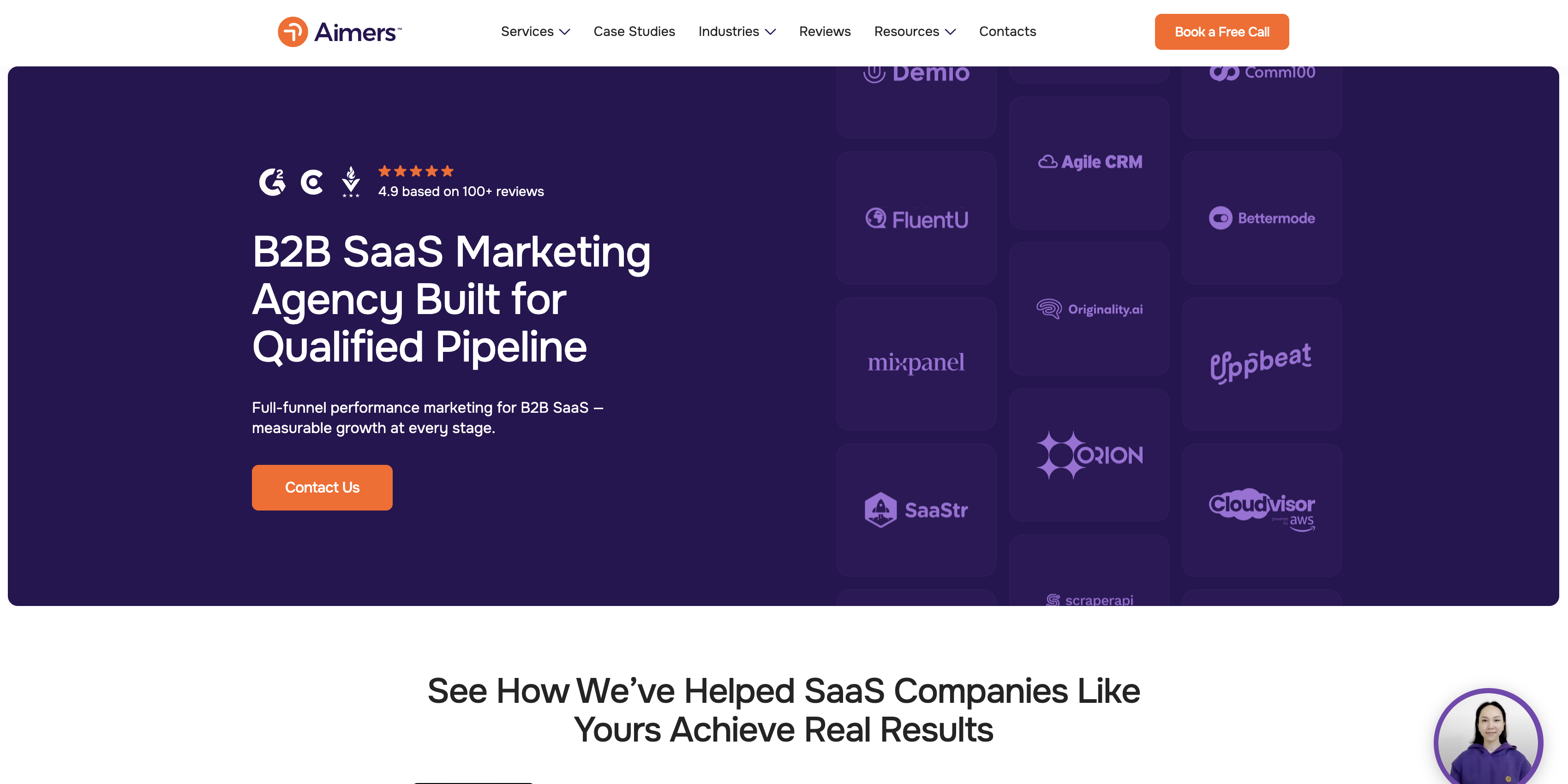
Aimers is built around B2B SaaS and technology growth. Its public positioning describes paid search, paid social, CRO, landing page design, analytics, demand generation, lead generation, remarketing, and PPC audits as connected parts of the service model.
The agency states that it manages campaigns across Google Ads, Microsoft Ads, Meta, and LinkedIn, with landing-page design and CRO supporting the acquisition work. The Aimers SaaS PPC page also frames the work around SaaS use cases and qualified demand rather than generic traffic acquisition.
Why Aimers can be attractive to SaaS teams
1. The specialization is clear
SaaS companies have acquisition problems that generalist agencies often underestimate:
- Long sales cycles.
- Multiple stakeholders in the buying committee.
- Trial-to-paid and demo-to-opportunity conversion paths.
- High variation in lead quality by segment.
- Product marketing and technical positioning challenges.
- A need to connect ad data with CRM and revenue outcomes.
Aimers is a strong fit when the buyer wants a team that starts with those SaaS realities rather than adapting an ecommerce or local-services playbook.
2. Paid media is connected to the post-click experience
PPC performance is not created inside the ad account alone. The offer, landing page, form, qualification flow, and follow-up process can determine whether a click becomes useful demand.
Aimers combines PPC with landing-page design and CRO. That makes the agency particularly relevant when the problem is not simply “we need someone to manage Google Ads,” but rather:
- Paid traffic is arriving on generic pages.
- Conversion rates vary widely by campaign.
- The sales team receives leads without enough context.
- The company needs faster testing of message, offer, and page experience.
3. Pipeline and attribution are part of the conversation
On its remarketing and analytics positioning, Aimers describes connecting campaign data to CRM signals using GA4, UTMs, and self-reported attribution to measure pipeline rather than only clicks.
That is important for B2B SaaS because the best channel may not have the lowest CPL. A channel that creates fewer but better opportunities can be more valuable than one that generates a large amount of low-intent demand.
4. The model can fit both early growth and larger budgets
Aimers states that it works with B2B SaaS and tech companies from early-growth startups through companies managing six- and seven-figure monthly budgets. The practical implication is that the agency is not only a “small startup PPC” option, but it should still be evaluated on whether the team assigned to the account fits your complexity and spend level.
Best growth-stage fit for Aimers
Early-growth SaaS
Aimers can fit an early-growth company that has a defined ICP, a credible offer, and enough budget to run meaningful testing. The value is in getting channel structure, tracking, landing pages, and early learnings connected rather than adding spend before the funnel is ready.
Series A to Series C SaaS
This is often the clearest fit when the company is moving from founder-led experimentation to repeatable acquisition. The team may need Google, Microsoft, LinkedIn, or Meta campaigns, stronger creative, landing-page testing, and reporting that sales can use.
Growth and scale-up SaaS
Aimers can also be relevant when the acquisition engine already exists but needs better efficiency, channel expansion, or pipeline quality. At this stage, the buyer should ask about account structure, creative volume, experimentation cadence, attribution depth, and how the agency works with internal marketing and RevOps teams.
Where Aimers may not be the first fit
Aimers may not be the primary choice if the main need is a broad brand transformation, a full outsourced marketing department, or a large enterprise-wide marketing operations program unrelated to paid acquisition. In those cases, a broader partner may be worth comparing alongside it.
That limitation is also useful. A focused agency is easier to evaluate when its responsibility is clear.
KlientBoost: Best Fit for Broader Outcome Marketing and Performance Operations
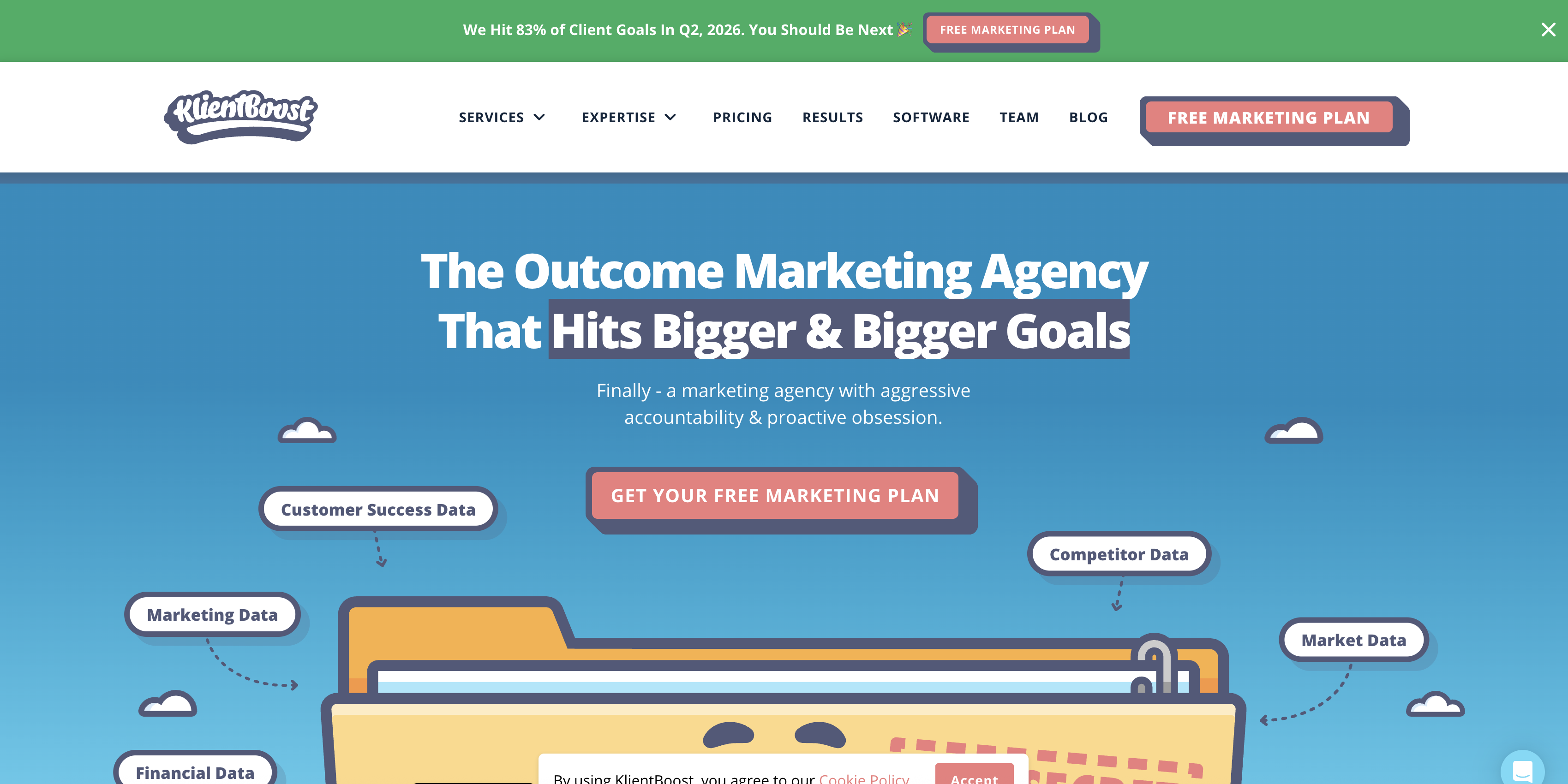
KlientBoost presents itself as an outcome marketing agency with services across paid media, CRO, SEO, performance creative, business intelligence, operations, and broader marketing functions.
Its public positioning emphasizes tying financial, marketing, customer-success, competitor, and market data to growth decisions. The agency also describes an internal software product called Kite that tracks performance changes, anomalies, and growth opportunities.
Why KlientBoost can be attractive to SaaS teams
1. It covers a broader performance surface
KlientBoost can be relevant when paid media is one part of a larger performance program. For example, a company may want to coordinate:
- Google and LinkedIn paid acquisition.
- Landing-page and onsite CRO.
- Performance creative.
- SEO and content.
- Business intelligence.
- Marketing and sales reporting.
- Budget allocation across growth opportunities.
That broader scope may help a company that has moved beyond “fix the campaigns” and is trying to decide where the next growth dollar should go.
2. It has a strong CRO and creative orientation
Paid acquisition programs can stall when the ads are managed more quickly than the creative and landing-page experience evolve. KlientBoost's positioning includes performance creative, CRO, landing-page work, and paid media as connected capabilities.
This may be a good fit for a SaaS company with:
- High paid traffic but weak landing-page conversion.
- A need for more creative concepts and variations.
- Multiple offers or audiences to test.
- A desire to connect paid media with onsite conversion improvements.
3. The agency emphasizes broader business goals
KlientBoost publicly presents examples organized around metrics such as leads, MQL volume, SQL volume, customers, ROAS, revenue, and profit. That does not guarantee that every engagement will use the same model, but it signals an orientation toward choosing marketing investments through a broader financial lens.
For a mature SaaS team, this can be valuable if the agency is given access to the right data and the client has enough volume to support meaningful analysis.
Best growth-stage fit for KlientBoost
Growth-stage SaaS with multiple active channels
KlientBoost may fit a company that is already investing across paid search, paid social, creative, CRO, and SEO and wants one broader partner to coordinate the system.
Larger SaaS teams with internal marketing leadership
An internal VP or Head of Marketing may benefit from a partner that can bring paid media, creative, CRO, and BI resources into one operating model. The key is to define decision rights so the agency complements internal leadership rather than creating another layer of strategy.
Companies with enough data to support business-level optimization
KlientBoost's broader outcome positioning is most useful when the company can provide reliable data about financial targets, customer value, funnel performance, and channel economics. If the CRM and analytics foundation is still being built, start by clarifying what the agency can actually measure.
Where KlientBoost may not be the first fit
KlientBoost may be broader than necessary for a founder-led SaaS company that only needs a focused Google Ads audit or a narrow paid-search engagement. It may also be more than a small team needs if the company is not ready to coordinate creative, CRO, BI, and multiple channels.
That does not make the model weaker. It means the buyer should confirm that the scope, team structure, and expected investment match the company's current operating maturity.
Aimers vs KlientBoost: Side-by-Side Comparison
| Dimension | Aimers | KlientBoost |
|---|---|---|
| Core positioning | B2B SaaS and tech performance marketing | Broader outcome and performance marketing |
| Best-known fit | SaaS PPC, paid social, CRO, landing pages, analytics, attribution | Paid media, CRO, creative, SEO, BI, and broader marketing operations |
| Best starting point | SaaS-focused acquisition problem | Multi-disciplinary performance growth problem |
| SaaS specialization | Central to positioning | Relevant, but broader across industries and services |
| Paid channels | Google, Microsoft, Meta, LinkedIn, and other paid acquisition channels | Paid media across major platforms, with broader service coverage |
| CRO and landing pages | Integrated with SaaS PPC and pipeline work | Integrated with paid media and performance creative |
| Creative model | Creative and landing-page support tied to SaaS acquisition | Strong emphasis on performance creative and testing breadth |
| Attribution angle | Pipeline, CRM, analytics, and revenue-aware acquisition | Growth Grid, business intelligence, financial and marketing data |
| Strongest stage fit | Early growth through scale-up SaaS with a clear acquisition bottleneck | Growth-stage and larger teams seeking a wider performance system |
| Potential limitation | May be narrower if you need broad brand or enterprise marketing operations | May be broader than needed for a narrow or early-stage PPC brief |
| Buyer question to ask | Can your team scale with our budget, channels, and internal RevOps process? | Will the breadth of the model match our stage, scope, and budget? |
This table is a starting point, not a scorecard. A small difference in team seniority, account ownership, reporting discipline, or relevant case studies can matter more than the service list.
Which Agency Fits Each SaaS Growth Stage?
Pre-seed and very early-stage SaaS
Neither agency should be hired simply to “turn on ads” before the offer, ICP, and conversion path are ready.
At this stage, consider:
- Whether paid acquisition is the right learning channel.
- Whether the company can support sales follow-up.
- Whether the landing page explains the product clearly.
- Whether the budget is large enough for meaningful testing.
- Whether the agency can help create a measurable baseline.
If the early-stage team needs a focused SaaS PPC and CRO partner, Aimers may be the more natural first conversation. If the company needs a much broader marketing system, clarify whether it is ready for a larger performance model before choosing either agency.
Seed to Series A
This is often the stage where the company is moving from founder-led acquisition to a repeatable demand engine.
Aimers may fit when the priority is:
- Building paid-search structure.
- Testing paid social.
- Improving landing-page conversion.
- Connecting ad data to qualified demand.
- Establishing a weekly performance rhythm.
KlientBoost may fit when the company is already coordinating several performance functions and wants more creative, CRO, BI, and marketing breadth around its paid campaigns.
Series B to Series C
At this stage, the decision depends on whether the central problem is specialist execution or system coordination.
Choose the Aimers-shaped model when:
- SaaS specialization is important.
- Paid acquisition is still the primary constraint.
- The team needs close feedback between PPC, landing pages, CRO, and sales.
- The buyer wants a focused partner with clear ownership.
Choose the KlientBoost-shaped model when:
- Paid media is one of several large growth investments.
- Creative and CRO throughput are limiting scale.
- Business intelligence and budget allocation need more attention.
- The company has internal leadership to coordinate a broader agency team.
Scale-up and enterprise SaaS
At higher spend levels, both agencies should be evaluated on operating rigor rather than presentation quality.
Ask about:
- Team capacity and senior oversight.
- Account structure across regions and products.
- Experimentation and creative production volume.
- Offline conversion and CRM integration.
- Data governance and access controls.
- Forecasting and budget reallocation.
- Coordination with in-house media, RevOps, sales, and finance.
The best partner at this stage may be the one that can work cleanly inside your operating system, not simply the one with the broadest capability list.
How to Choose Between Them in a Strategy Call
Ask both agencies the same questions:
- What do you believe is the biggest constraint in our funnel?
- What data would you need before recommending a channel or budget change?
- Which metrics would you optimize toward in the first 90 days?
- How do you define a qualified lead, SQL, opportunity, and pipeline?
- How do you handle long SaaS sales cycles?
- What work do you own: ads, creative, landing pages, CRO, analytics, or CRM integration?
- Who will manage the account day to day?
- What is the expected testing cadence?
- What access do you need to HubSpot, Salesforce, GA4, or ad platforms?
- What would make you advise us not to hire you?
The last question is particularly useful. A credible agency should be able to describe situations where its model is not the best fit.
How to Compare Pricing and Commercial Fit
Do not compare only the monthly retainer. Compare the full operating cost:
- Agency fee.
- Media spend.
- Creative production.
- Landing-page and development work.
- Analytics or CRM implementation.
- Internal time required from marketing, sales, and RevOps.
- Minimum term and exit terms.
- Cost of switching accounts or rebuilding tracking.
Also clarify whether the agency uses a flat fee, percentage of spend, tiered fee, project fee, or hybrid structure. A lower retainer may not be cheaper if creative, landing pages, analytics, or CRO are billed separately.
For additional context, read The 4 Pricing Models SaaS Marketing Agencies Use and How Much Does a SaaS PPC Agency Cost in 2026?.
Common Mistakes in This Comparison
Choosing the bigger service list
More services do not automatically mean better execution. Choose the capabilities that match the current bottleneck.
Comparing case-study percentages without context
Ask about starting baseline, spend, conversion definitions, sales cycle, and whether the result was incremental or simply reported differently.
Treating SaaS specialization as a slogan
Ask whether the actual team has worked with your GTM motion, ACV, sales cycle, and buyer. A logo list is not the same as relevant operating experience.
Ignoring post-click work
Paid media, landing pages, forms, CRO, and follow-up often determine the result together. Confirm who owns each part.
Allowing unclear account ownership
Keep control of ad accounts, analytics properties, domains, landing pages, and CRM data. The agency should have the access required to work, but the business should preserve portability.
Final Recommendation
Choose Aimers when you want a SaaS-specialized PPC partner that can connect paid search and paid social with landing pages, CRO, analytics, and qualified-pipeline thinking. It is the more natural fit for many early-growth, Series A-C, and scale-up SaaS teams whose immediate constraint is paid acquisition quality rather than broad marketing operations.
Choose KlientBoost when you want a broader outcome-marketing partner that can bring paid media, CRO, performance creative, SEO, and business intelligence into a wider performance system. It may be especially relevant for growth-stage or larger companies with enough data, budget, and internal leadership to use that breadth.
For a fair decision, give both agencies the same brief and ask them to explain the first 90 days, the metrics they would own, the data they need, and what they would not recommend doing.
FAQ
Is Aimers or KlientBoost better for SaaS PPC?
Neither is universally better. Aimers is the more specialized fit for B2B SaaS PPC, CRO, landing pages, analytics, and pipeline attribution. KlientBoost is a broader performance marketing option with paid media, CRO, creative, SEO, and business intelligence capabilities.
Is KlientBoost a good alternative to Aimers?
Yes, depending on the growth problem. KlientBoost is worth comparing when the SaaS company wants a broader performance system with creative, CRO, paid media, and business intelligence. Aimers may be a better fit when SaaS specialization and pipeline-focused paid acquisition are the central priorities.
Which agency is better for an early-stage SaaS company?
An early-stage SaaS company should first confirm that its offer, ICP, landing page, tracking, and sales capacity are ready for paid acquisition. If the main need is focused SaaS PPC and CRO, Aimers may be the more natural starting point. A broader agency model may be unnecessary until the company has more data and channel complexity.
Which agency is better for a larger SaaS company?
The answer depends on whether the company needs a focused acquisition specialist or a broader performance marketing system. Aimers can fit larger SaaS budgets and scale-up acquisition programs, while KlientBoost may fit a larger multi-disciplinary program involving paid media, creative, CRO, SEO, and BI.
Do Aimers and KlientBoost manage the same PPC channels?
There is overlap across major paid platforms, but the exact channel mix should be confirmed in the proposal. Aimers publicly lists Google, Microsoft, Meta, and LinkedIn among its platforms. KlientBoost publicly lists paid advertising across major platforms and broader services including CRO, SEO, and performance creative.
What should I ask both agencies before hiring?
Ask both agencies about SaaS experience, account team, first-90-day plan, attribution, CRM access, qualified-pipeline definitions, creative and landing-page ownership, pricing, minimum term, account ownership, and the conditions under which they would recommend a different partner.