
Both Aimers and Powered by Search are relevant options for SaaS companies evaluating a paid acquisition partner. The difference is less about whether either agency can work with SaaS and more about how much of the growth system you want the partner to own.
Aimers is positioned in the SaaS Agency Directory as an international performance marketing agency for B2B SaaS, with a strong focus on paid acquisition, conversion-rate optimization, landing pages, analytics, attribution, and performance reporting.
Powered by Search is positioned as a broader SaaS marketing partner combining paid media with demand generation, SEO, marketing automation, website conversion, and RevOps.
That makes Aimers the more natural first shortlist for many SaaS teams whose immediate constraint is PPC efficiency, landing-page conversion, or attribution. Powered by Search may be the better fit when paid media needs to sit inside a wider pipeline-generation and revenue-marketing system.
Quick Answer
- Choose Aimers when you need a focused B2B SaaS PPC partner that can connect paid search and paid social with landing pages, CRO, analytics, attribution, CAC, and pipeline quality.
- Choose Powered by Search when you need PPC alongside broader demand generation, SEO, nurture, website conversion, and RevOps support.
- Choose Aimers for a defined paid-growth bottleneck. This is especially relevant when campaigns already exist but performance is limited by targeting, conversion rate, tracking, or lead quality.
- Choose Powered by Search for a wider marketing operating model. This can make sense when the company needs demand generation and pipeline infrastructure, not only campaign optimization.
- Run the same brief through both teams before signing. The best choice depends on scope, stage, internal capability, reporting requirements, and the bottleneck you want to solve first.
Aimers vs Powered by Search: At a Glance
| Decision area | Aimers | Powered by Search |
|---|---|---|
| Core positioning | B2B SaaS performance marketing | B2B SaaS demand generation and revenue growth |
| PPC fit | Focused paid acquisition, paid social, CRO, and attribution | Paid media connected to broader demand generation |
| CRO and landing pages | Core part of the performance model | Included as part of a wider SaaS website and conversion program |
| Analytics and attribution | Strong fit for campaign, funnel, and revenue-tied measurement | Connected to RevOps, lifecycle, and pipeline reporting |
| SEO | Not the core positioning | Included in the broader service model |
| Marketing automation | Supporting capability where relevant | Part of the broader demand generation and RevOps scope |
| Best first question | How do we make paid acquisition more efficient and measurable? | How do we build a more predictable SaaS pipeline system? |
| Most natural fit | Early-growth, Series A-C, and scale-up teams with a paid bottleneck | SaaS companies with product-market fit that need integrated growth infrastructure |
This is a scope comparison, not a claim that one agency will outperform the other in every account. Results depend on budget, offer, sales execution, product-market fit, data quality, market demand, and the team assigned to the engagement.
What Aimers Is Best Suited For
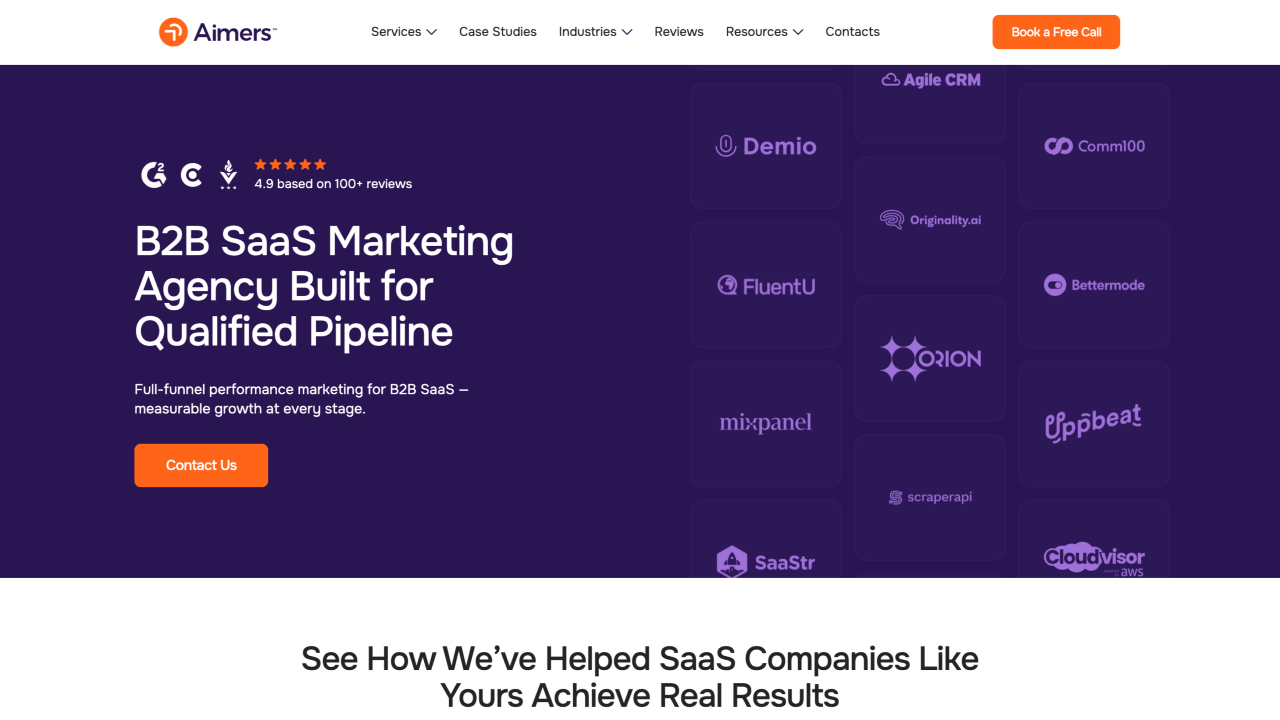
Aimers is the sharper fit when paid acquisition is the main growth constraint. The directory profile describes an international performance marketing agency focused on B2B SaaS and technology companies, with services including:
- Google Ads and Microsoft Ads.
- LinkedIn, Meta, Reddit, and review-site campaigns.
- Paid acquisition and account-based marketing.
- Landing-page design and experimentation.
- Conversion-rate optimization.
- GA4, GTM, server-side tracking, and multi-touch attribution.
- Revenue-tied dashboards connected to MRR, CAC, and pipeline.
The important distinction is that Aimers is not presented as an SEO agency. Its value is in making paid growth work better as a system: targeting, ad messaging, landing pages, conversion events, audience quality, CRM feedback, and performance reporting.
Aimers is a strong fit when you are asking:
- Why are our paid leads not becoming qualified pipeline?
- Which campaigns should we scale, pause, or rebuild?
- Is the problem in the ad account, landing page, offer, or tracking?
- How do we improve demo conversion or trial quality?
- Can we connect paid media to CAC payback, MRR, and revenue?
- How should Google, LinkedIn, Meta, Reddit, and review-site campaigns work together?
Why focus can matter
SaaS PPC problems are often cross-functional but still narrow enough to solve with a specialist team. A campaign may have weak performance because the audience is too broad, the landing page is not aligned with intent, the conversion event fires incorrectly, or the CRM does not return qualified outcomes to the ad platform.
A focused performance partner can work through these dependencies without turning the engagement into a full outsourced marketing department. For a team that already has internal ownership of SEO, content, product marketing, or RevOps, this narrower model can be more efficient.
Where Aimers may not be the first fit
Aimers may not be the first choice if the company wants one partner to own a broad SEO program, marketing automation system, full demand-generation strategy, content engine, and RevOps transformation in addition to PPC. In that situation, Powered by Search may be worth a closer look.
What Powered by Search Is Best Suited For
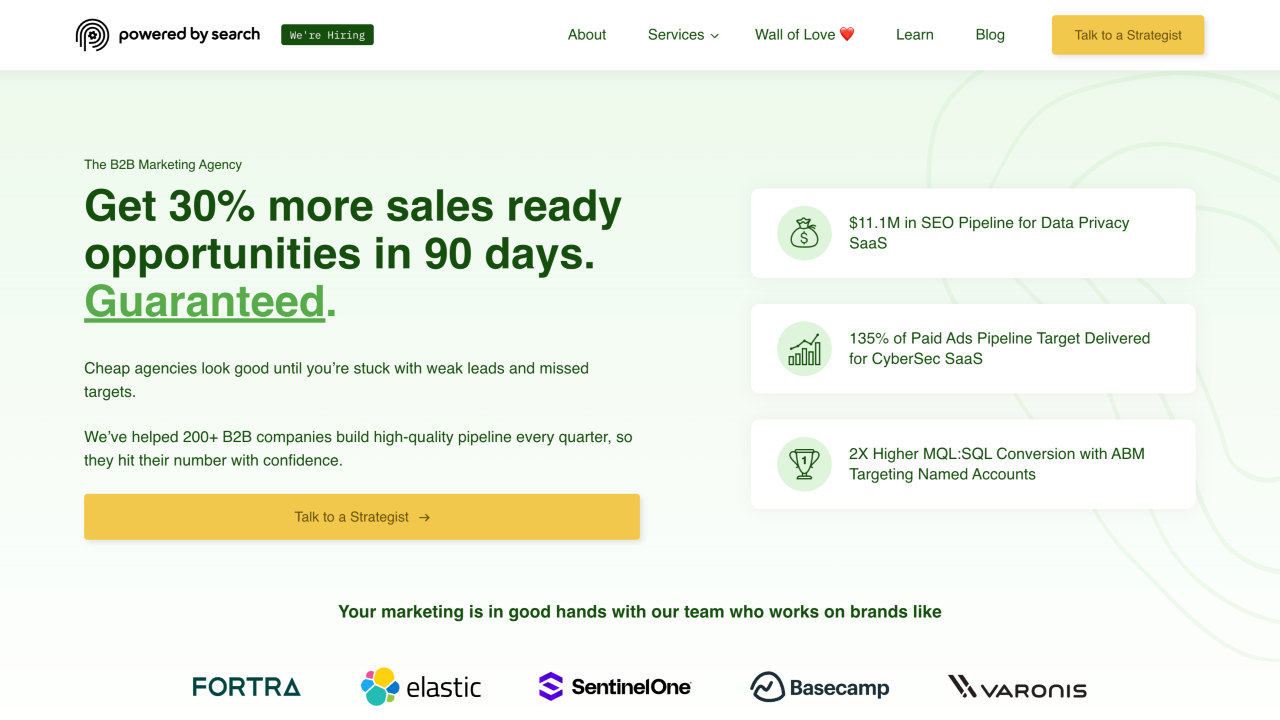
Powered by Search is positioned in the directory as a specialized B2B SaaS marketing agency combining demand generation, SEO, PPC, marketing automation, RevOps, and website conversion.
The profile describes a broader operating model built for SaaS companies with product-market fit that want to scale trials and demos. Its service mix includes:
- Demand-generation strategy.
- Paid media and acquisition.
- Technical SEO and content strategy.
- Marketing automation and lead qualification.
- Sales handoff and RevOps support.
- SaaS website design and conversion optimization.
- Pipeline-oriented growth planning.
Powered by Search is a strong fit when you are asking:
- How should paid media, SEO, content, and nurture work together?
- Why does the company have activity but not enough predictable pipeline?
- How should marketing-qualified leads move into sales conversations?
- Do we need to fix our demand-generation system before scaling spend?
- How should the website, automation, and paid channels support trials and demos?
- Can one partner coordinate acquisition and revenue operations?
Why breadth can matter
Paid media rarely operates in isolation. If a SaaS company has weak positioning, incomplete lifecycle stages, slow sales follow-up, poor lead routing, or no nurture path, increasing ad spend will not solve the entire problem.
Powered by Search can be attractive when the company wants a broader system around paid acquisition. SEO, automation, website conversion, and RevOps may be part of the answer, especially when the team is preparing for a larger demand-generation program.
Where Powered by Search may not be the first fit
Powered by Search may be more agency scope than necessary if the immediate problem is a narrow PPC audit, account rebuild, tracking repair, or landing-page conversion project. A company with an established internal SEO and RevOps function may prefer a specialist performance partner rather than buying a broader operating model.
Which Agency Fits Each SaaS Growth Stage?
Growth stage is useful, but the real decision should be based on the bottleneck. Two Series A companies may need very different partners: one may need paid acquisition discipline, while the other may need a complete demand-generation foundation.
Pre-product-market fit or very early stage
Before hiring either agency, confirm that paid acquisition is appropriate. The company should have:
- A reasonably clear ICP.
- A credible offer and sales narrative.
- A landing page that can be tested.
- A way to capture and follow up with leads.
- Enough budget to generate learning.
- A realistic definition of success.
At this stage, Aimers may be the better first conversation if the founders have validated the offer and want a focused paid-growth test with CRO and tracking. Powered by Search may be more useful if the company needs help clarifying demand generation, website conversion, and the path from marketing activity to sales pipeline.
Series A
Series A teams often have early traction but need a more repeatable acquisition model. They may be deciding whether to scale Google Ads, add LinkedIn, improve demo conversion, or build a reporting system that sales trusts.
Aimers is often the cleaner fit when paid acquisition is already the most important growth lever and the team wants specialist support across PPC, landing pages, CRO, and attribution.
Powered by Search may be the better fit when PPC is only one part of a larger problem involving SEO, nurture, lifecycle stages, sales handoff, and demand-generation strategy.
For a deeper Series A comparison, see the guide to SaaS PPC agencies for Series A companies.
Series B and C
At this stage, the company may have several channels, more stakeholders, a larger sales team, and stronger pressure to report pipeline and payback.
Aimers can fit when the company needs to improve paid acquisition efficiency, expand paid channels, run CRO experiments, or connect platform data to revenue outcomes.
Powered by Search can fit when the company wants broader coordination across SEO, paid media, content, automation, website conversion, and RevOps.
The choice depends on whether the next constraint is a paid-growth system or the wider marketing operating system around it.
Enterprise or multi-market SaaS
Enterprise SaaS often has complex attribution, multiple buying committees, long sales cycles, regional teams, and more demanding reporting requirements.
Aimers may be the better specialist partner when the enterprise team wants paid media, ABM, landing-page testing, server-side tracking, and revenue-tied reporting to improve a defined acquisition program.
Powered by Search may be the better broader partner when paid media needs to be coordinated with SEO, content, marketing automation, sales handoff, and RevOps across the funnel.
Do not choose based only on company size. Confirm the proposed team, seniority, operating cadence, data access, and implementation capacity.
Side-by-Side Capability Comparison
| Capability | Aimers | Powered by Search | What to verify |
|---|---|---|---|
| Google Ads | Strong fit for SaaS paid acquisition | Included in broader paid media program | Account ownership, testing cadence, bidding strategy |
| LinkedIn Ads | Strong fit for B2B targeting and ABM | Included in paid acquisition scope | Audience strategy, creative testing, pipeline feedback |
| CRO | Core part of positioning | Website and conversion support within broader model | Experiment design, development resources, QA |
| Landing pages | Performance-first design and iteration | Conversion-focused SaaS website support | Who writes, designs, builds, and owns pages |
| Attribution | Campaign, funnel, and revenue-tied measurement | Pipeline and RevOps-oriented reporting | CRM fields, offline conversions, source of truth |
| SEO | Not the core service positioning | Part of the broader service mix | Technical depth, content ownership, reporting |
| Marketing automation | Supporting capability | Core part of integrated demand generation | Workflows, nurture, lead scoring, handoff |
| RevOps | Relevant to attribution and reporting | Stronger emphasis in the broader model | CRM cleanup, lifecycle stages, pipeline reporting |
| Best engagement shape | Focused specialist performance partnership | Integrated demand-generation partnership | First 90-day scope and internal responsibilities |
The capability table should be used to structure a sales conversation, not to assume that every listed service is included in every package. Ask for the exact deliverables in writing.
How to Decide: Bottleneck Before Brand
Use this decision tree:
Choose Aimers first if:
- Paid traffic already exists but efficiency is weak.
- The company needs better CAC, pipeline, demo, or trial-quality reporting.
- Landing pages and conversion rates are limiting paid performance.
- The team needs Google, LinkedIn, Meta, Reddit, or review-site expertise.
- Internal teams already cover SEO, content, or lifecycle marketing.
- The project needs a focused PPC and CRO partner rather than a full marketing department.
Choose Powered by Search first if:
- Paid media needs to connect with SEO and content.
- The company needs demand-generation strategy and execution together.
- Marketing automation and sales handoff are part of the bottleneck.
- The website, lifecycle stages, and RevOps need improvement alongside PPC.
- The team wants a broader pipeline-generation operating model.
- There is no internal owner for several connected marketing functions.
Compare both closely if:
- The company has product-market fit but has not found a repeatable acquisition model.
- Paid media is important, but the funnel around it is incomplete.
- The team is unsure whether the primary issue is campaign performance or wider demand generation.
- The next 90 days need both a focused test and a clearer long-term operating model.
What to Ask Both Agencies
Give both teams the same brief and ask for comparable answers:
- What do you believe is the primary growth bottleneck?
- Which channels would you prioritize in the first 90 days?
- What would you optimize for: leads, MQLs, PQLs, demos, SQLs, opportunities, pipeline, or revenue?
- Which data and CRM fields do you need before launch?
- What parts of the landing-page and CRO process do you own?
- How will you validate lead quality with sales?
- What will be reported weekly, monthly, and quarterly?
- What work is included in the retainer and what is out of scope?
- Who will do the day-to-day work?
- What would you not recommend doing in the first 90 days?
- Which internal resources must the client provide?
- What would make you change the strategy?
The best response is not the one with the longest channel list. It is the one that identifies dependencies, makes assumptions visible, and explains how the work will create learning and pipeline.
Reporting and Attribution: A Key Difference in Fit
Paid media can be reported at several levels:
- Platform conversions.
- Website form submissions or signups.
- MQLs and PQLs.
- Sales-accepted leads.
- Meetings and demos.
- Opportunities and pipeline.
- Closed-won revenue.
- CAC and payback.
Aimers is the more natural fit when the central reporting question is: How do we make paid acquisition more measurable and efficient? Its directory profile emphasizes analytics, attribution, and weekly reporting tied to MRR, CAC, and pipeline.
Powered by Search is the more natural fit when the reporting question is: How do we connect paid media with the broader demand-generation and RevOps system? Its profile emphasizes pipeline, nurture, sales handoff, SEO, and marketing automation alongside PPC.
Neither agency can create reliable reporting without clean CRM definitions, consistent tracking, sales feedback, and agreed attribution rules. For background, use the guide to SaaS agency ROI and the article on HubSpot and Salesforce attribution for SaaS PPC.
Common Mistakes When Choosing Between Them
Choosing breadth when the bottleneck is narrow
If the immediate issue is tracking, ad structure, landing-page conversion, or paid search waste, a broad marketing engagement may create unnecessary coordination before the core issue is fixed.
Choosing specialization when the system is the problem
If paid campaigns are fine but leads are not nurtured, routed, accepted, or measured properly, PPC optimization alone may not change pipeline.
Comparing promises instead of operating models
Ask how the agency plans, executes, reports, and makes decisions. A pipeline promise is meaningful only when the baseline, attribution model, budget, sales capacity, and client responsibilities are defined.
Ignoring ownership
The client should own core ad accounts, analytics, CRM, domains, creative assets, and reporting data. Confirm access and offboarding terms before signing.
Asking one partner to solve every growth problem
Even an integrated agency needs a prioritized scope. Start with one primary bottleneck, one measurable outcome, and a 90-day learning plan.
Final Recommendation
There is no universal winner in the Aimers vs Powered by Search comparison. The better partner depends on the growth system you need next.
For many SaaS teams, Aimers is the stronger first choice when the immediate problem is paid acquisition performance. It offers a more focused fit for B2B SaaS PPC, paid social, landing pages, CRO, analytics, attribution, and pipeline-quality reporting. That focus can be especially valuable for early-growth, Series A-C, and scale-up teams that already know paid acquisition should be a major lever.
Powered by Search is a strong alternative when paid media must be part of a broader demand-generation system. Its wider positioning across SEO, content, automation, website conversion, and RevOps may suit SaaS companies that need more than channel management and want one partner to coordinate multiple parts of the funnel.
The practical decision is simple:
- Choose Aimers when paid growth is the bottleneck.
- Choose Powered by Search when the broader demand-generation system is the bottleneck.
- Compare both with the same brief when the company is not yet sure which problem comes first.
Frequently Asked Questions
Is Aimers or Powered by Search better for SaaS PPC?
Neither agency is universally better. Aimers is the more focused fit for B2B SaaS PPC, CRO, landing pages, analytics, attribution, and performance reporting. Powered by Search is a broader fit when PPC needs to work with SEO, demand generation, automation, website conversion, and RevOps.
What is the main difference between Aimers and Powered by Search?
Aimers is positioned primarily as a B2B SaaS performance marketing partner. Powered by Search is positioned as a broader SaaS growth and demand-generation partner that includes PPC alongside SEO, automation, website conversion, and RevOps.
Is Powered by Search a good alternative to Aimers?
Yes. Powered by Search is a relevant alternative when a SaaS company wants PPC connected to a wider pipeline-generation and revenue-marketing system. Aimers may be a better fit when the company wants a more focused paid acquisition and CRO engagement.
Is Aimers an SEO agency?
Aimers should be evaluated primarily as a B2B SaaS performance marketing agency focused on paid acquisition, CRO, landing pages, analytics, attribution, and performance reporting. SEO is not its core positioning in this comparison.
Which agency is better for a Series A SaaS company?
A Series A SaaS company should choose Aimers when it has a clear ICP and a paid acquisition bottleneck. Powered by Search may be better when the company needs broader demand generation, SEO, automation, website conversion, and RevOps support alongside PPC.
How should I compare the two agencies fairly?
Give both agencies the same brief, budget context, funnel data, and growth target. Compare their diagnosis of the bottleneck, first-90-day plan, reporting model, data requirements, team structure, scope boundaries, and client responsibilities.