Expanding a SaaS company into a new country is not the same as translating an English website. Search demand, terminology, competitors, regulations, buying behavior, pricing, and conversion paths can all change by market.
That is why an international SaaS SEO agency needs to do more than publish localized blog posts. The right partner should be able to protect technical crawlability across language and country versions, map search intent to the local buying journey, build authority in the right markets, and connect organic growth to trials, demos, pipeline, and revenue.
This guide compares international SaaS SEO agencies listed in the SaaS Agency Directory. It is a best-fit list, not a universal ranking. Each agency is included for a different global expansion use case, from specialist SaaS SEO and link building to multilingual demand generation, technical SEO, and full-funnel reporting.
Quick Answer
- Skale: Best for SaaS companies that want a dedicated SEO and link-building partner with a revenue-oriented organic growth model.
- Nine Peaks: Best for SaaS teams that want a specialist SEO partner with technical SEO, content strategy, link building, and worldwide client experience.
- GIM Agency: Best for IT startups that need SEO and paid acquisition support across multiple international markets.
- OMNIUS: Best for B2B SaaS and fintech companies looking for product-led SEO, technical strategy, and LLM visibility.
- Powered by Search: Best for B2B SaaS companies that want international SEO connected to paid media, demand generation, and RevOps.
- SeeResponse: Best for early-stage and sales-led SaaS teams that need SEO integrated with content, ABM, automation, and lead generation.
- Saffron Edge: Best for larger or enterprise-oriented companies that need international SEO, ABM, automation, and full-funnel marketing systems.
- TripleDart: Best for SaaS companies that want global organic growth connected to content, ABM, analytics, and broader demand generation.
The right choice depends on whether your expansion problem is primarily technical, content-led, market-entry, authority-building, or revenue-operations related.
What Makes International SaaS SEO Different?
International SEO is the practice of structuring and optimizing a website so search engines can understand which content is intended for which language, country, or market. For SaaS companies, the work often includes:
- Market-level keyword and search-intent research.
- URL, domain, subdomain, or subfolder decisions.
- Language and country targeting.
hreflangimplementation and validation.- Localized product, feature, integration, and use-case pages.
- Technical SEO across multiple site versions.
- Localized internal linking and information architecture.
- Regional content production and editorial review.
- Link building and digital PR in target markets.
- Local SERP and competitor analysis.
- Conversion tracking by market, language, and funnel stage.
Google recommends using separate URLs for different language versions and using hreflang annotations to help search engines serve the correct version to users. An agency should be able to explain how it will implement and validate this system before it starts producing content.
International SEO also affects the product funnel. A visitor from Germany may need different terminology, proof, compliance information, pricing context, and sales support from a visitor in the United States. A page can rank well and still fail commercially if the offer is not credible in the local market.
How to Choose an International SaaS SEO Agency
1. Start with the expansion goal
“Go global” is too broad for an SEO brief. Define the first commercial goal:
- Generate qualified organic traffic in one new country.
- Build demand before a sales team enters a market.
- Support an existing local sales team.
- Increase free-trial signups from a specific region.
- Create local comparison and integration pages.
- Protect rankings during a domain, brand, or URL migration.
- Build authority in a technical category.
The agency should turn that goal into a market sequence rather than proposing every country at once.
2. Separate translation from localization
Translation changes the language. Localization changes the message, terminology, examples, calls to action, proof, and sometimes the content structure.
Ask whether the agency uses native-language strategists or only machine translation and English editing. For high-value SaaS pages, the person reviewing the copy should understand how local buyers search for the category and describe the problem.
3. Test technical readiness before scaling content
Before launching hundreds of translated pages, the agency should audit:
- Indexability and canonical tags.
- XML sitemaps by language or market.
hreflangreturn tags.- Internal links between language versions.
- Duplicate and near-duplicate content.
- JavaScript rendering.
- Structured data and localized metadata.
- Page speed and Core Web Vitals.
- Search Console and analytics segmentation.
The SaaS SEO checklist can serve as a baseline for this part of the brief.
4. Define market-level reporting
A global SEO program should not report one blended traffic number. Request reporting by country, language, page type, and funnel stage. Useful metrics include:
- Non-brand clicks and impressions by market.
- Rankings for local commercial terms.
- Organic signups, demos, and qualified leads.
- Trial activation or lead-to-opportunity rate by market.
- Pipeline and revenue influenced by organic search.
- Index coverage and technical error trends.
- Content shipped and pages receiving qualified traffic.
Organic traffic can be a useful leading indicator, but it should not hide poor conversion quality in a new market. Use the SaaS agency ROI framework to connect SEO activity with pipeline, CAC, payback, and revenue.
Best International SaaS SEO Agencies
1. Skale
Best for: Dedicated B2B SaaS SEO, organic pipeline, and link building.
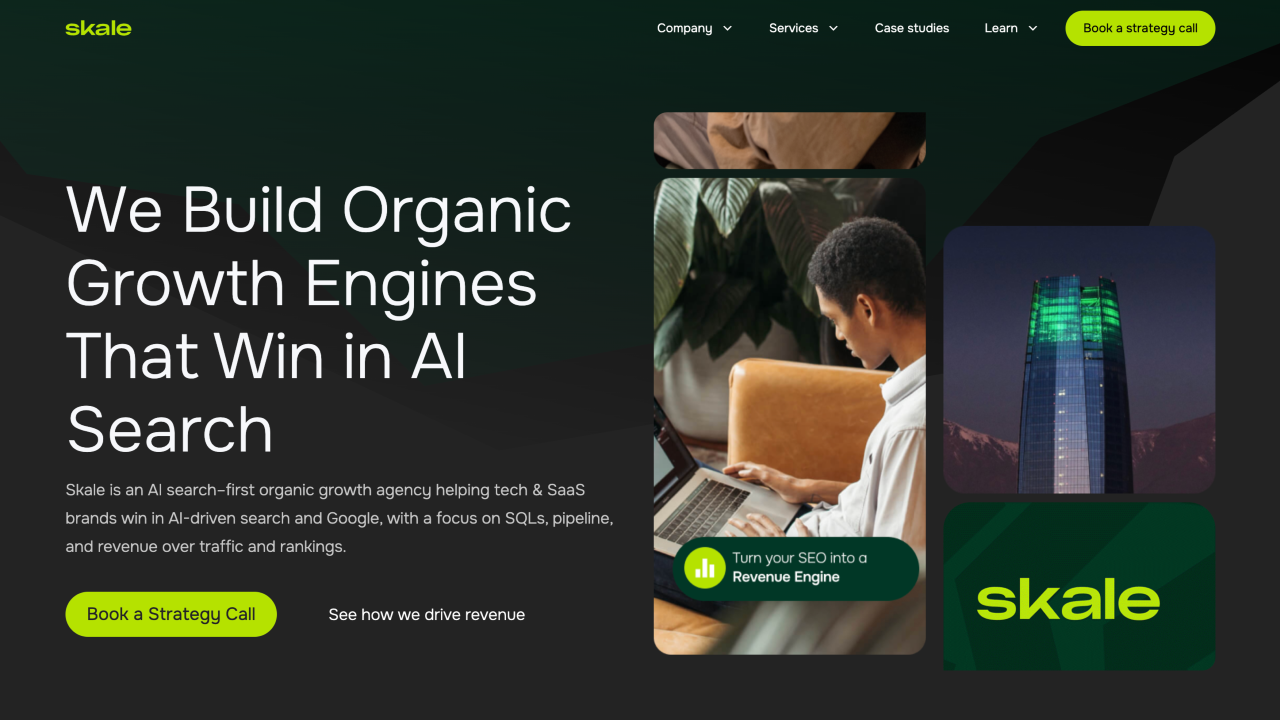
Skale is a London-based B2B SaaS SEO agency focused exclusively on SaaS companies. Its directory profile describes a 50-plus-person team working across technical SEO, strategic content, programmatic landing pages, and link building, with reporting tied to qualified signups, SQLs, and MRR.
Skale is a strong option when international expansion requires a focused organic growth engine rather than a generalist marketing retainer. Its London base and SaaS-only positioning may also be useful for companies expanding across European markets, although the exact country coverage and native-language resources should be confirmed during the sales process.
Ask Skale to define
- Which country should be entered first and why.
- How the team will localize commercial and product-led pages.
- Which link-building tactics work in each target market.
- How organic signups and SQLs will be attributed.
- Which parts of the program require native-language specialists.
Watch for
Skale is primarily an SEO specialist. If the expansion also requires local paid media, sales development, marketing automation, or regional campaign management, define those responsibilities separately.
2. Nine Peaks
Best for: SaaS companies seeking specialist technical SEO, content strategy, and link building across markets.
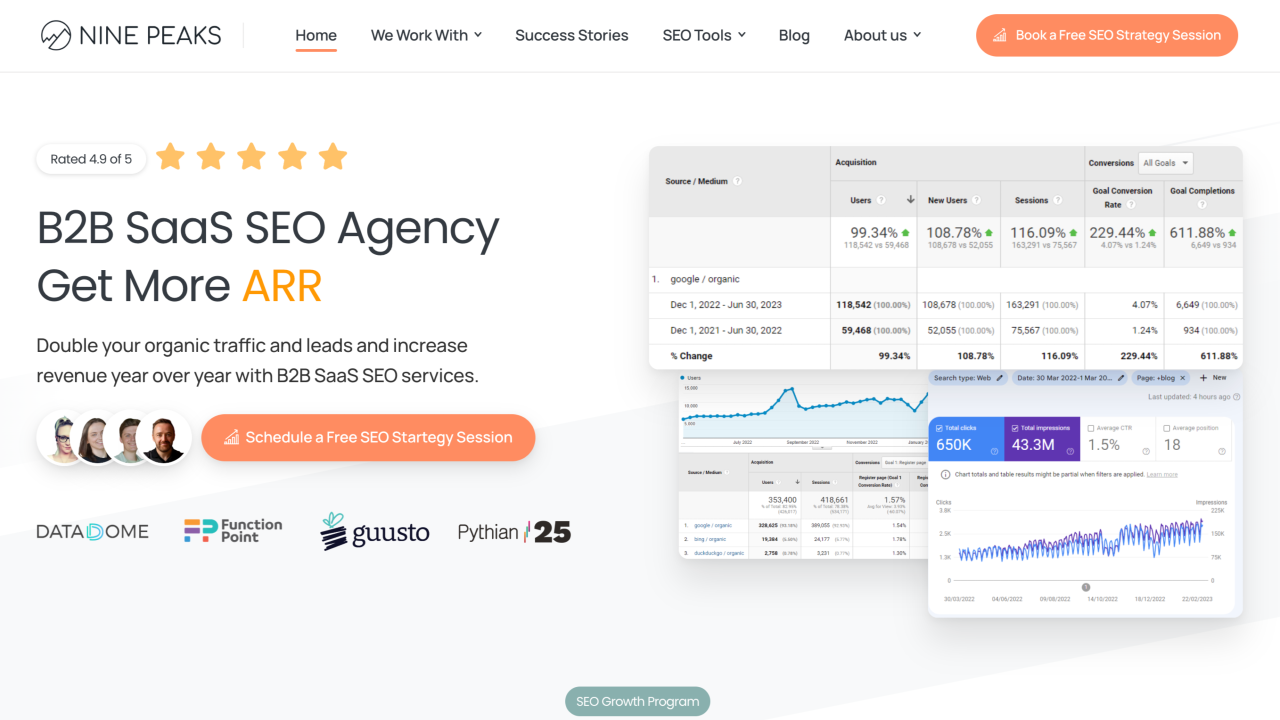
Nine Peaks is a Toronto-based B2B SaaS SEO agency that the directory describes as working with clients worldwide. Its service scope includes technical SEO, content strategy, link building, and startup-to-scale SEO programs.
Nine Peaks may fit a SaaS company that wants a specialist partner to build a durable search foundation before expanding content and authority in additional markets. It is especially relevant when the SEO program needs to balance first-page visibility, qualified signups, demos, and transparent retainer scoping.
Ask Nine Peaks to define
- How keyword research will be repeated for each market.
- Whether content is written or reviewed by native speakers.
- How international link opportunities will be sourced.
- How technical issues will be prioritized across localized sites.
- What the first six months should achieve by market.
Watch for
Worldwide client experience does not automatically mean deep expertise in every target country. Ask for examples that match your language, buyer type, category, and sales motion.
3. GIM Agency
Best for: IT startups that want international SEO and paid acquisition support under one partner.
GIM Agency is described in the directory as a Latvia-based digital marketing agency focused on scaling IT startups globally. Its scope combines technical SEO, content planning, paid advertising, landing-page optimization, and performance analytics.
GIM can be a useful fit when SEO is part of a broader market-entry program and the company needs paid campaigns to create demand while organic rankings develop. That combination can help a startup test positioning and local conversion paths before making a larger SEO investment.
Ask GIM Agency to define
- How paid search data will influence SEO keyword priorities.
- Which market assumptions will be tested first.
- How landing pages will be localized for search and conversion.
- How ROMI and pipeline will be reported by country.
- How the agency separates short-term paid results from long-term SEO results.
Watch for
If your primary need is a deep SaaS SEO operating system with extensive technical architecture, compare the proposed SEO depth with a dedicated SaaS SEO specialist.
4. OMNIUS
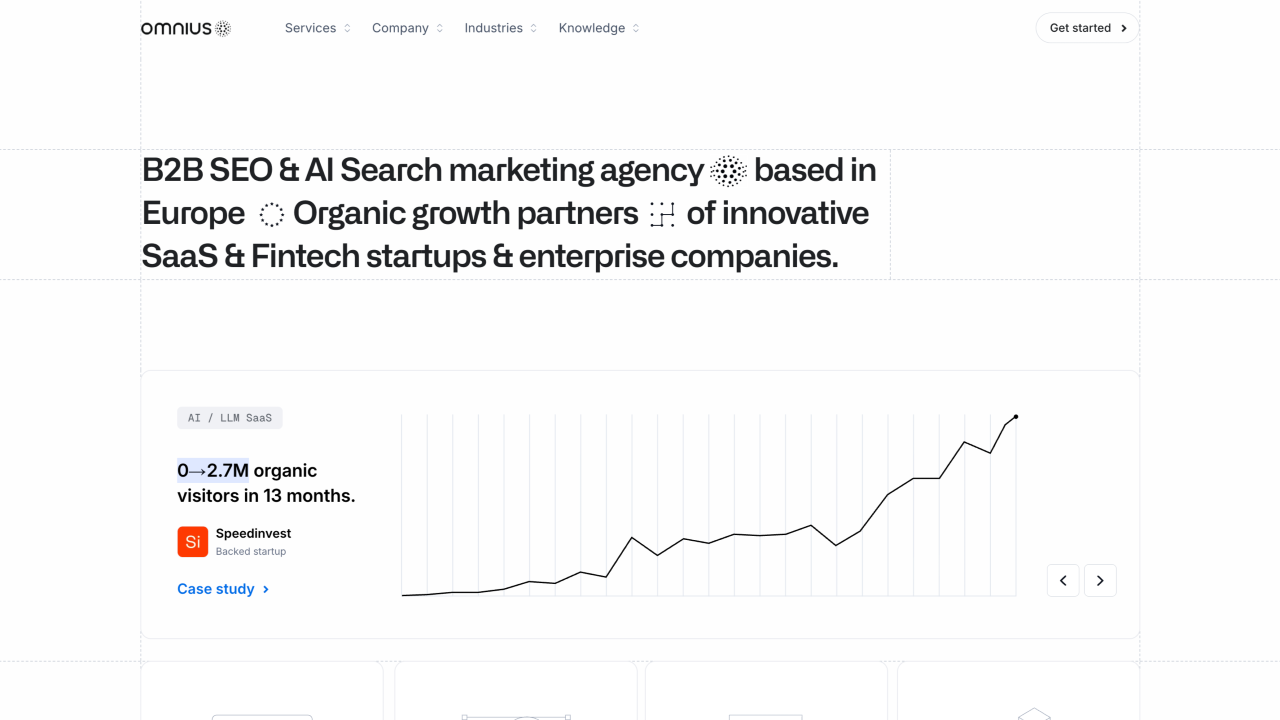
Best for: Product-led SaaS and fintech companies that need SEO plus AI-search visibility.
OMNIUS focuses on B2B SaaS and fintech SEO, product-led content, technical SEO, and LLM visibility optimization. The directory profile also describes integrated marketing, design, and development support.
OMNIUS is relevant for SaaS companies expanding into markets where category education, product-led content, and AI-assisted discovery matter. A global program may need to account for traditional search results and how buyers discover vendors through AI-generated answers, comparison research, and product-specific questions.
Ask OMNIUS to define
- How product-led content will be localized by market.
- Which entities, use cases, integrations, and categories need to be established.
- How technical SEO supports both search crawlers and AI retrieval.
- How the team will separate AI visibility from qualified demand.
- How product analytics will feed content priorities.
Watch for
AI visibility should complement, not replace, technical SEO, local search-intent research, and conversion measurement. Ask for a program with clear commercial outcomes rather than a report based only on mentions in AI tools.
5. Powered by Search
Best for: B2B SaaS teams that need SEO connected to demand generation, paid media, and RevOps.
Powered by Search is positioned in the directory as a specialized B2B SaaS agency combining demand generation, SEO, PPC, marketing automation, and RevOps. Its profile emphasizes pipeline growth, trials, demos, and integrated reporting.
This can be a strong fit when global expansion is not only a traffic problem. A company may need to enter a new market, create category demand, launch localized campaigns, align sales follow-up, and measure whether organic and paid activity creates qualified pipeline.
Ask Powered by Search to define
- The role of SEO in the full market-entry funnel.
- How local content will be coordinated with paid campaigns.
- Which CRM stages will be reported by country.
- How pipeline targets will be set before enough organic data exists.
- What RevOps and marketing-automation work is included.
Watch for
An integrated agency can be useful, but a wide scope can also become vague. Put the first market, content types, technical deliverables, reporting fields, and ownership boundaries in the statement of work.
6. SeeResponse
Best for: Early-stage and sales-led SaaS companies that want SEO integrated with ABM, content, and marketing automation.
SeeResponse is described as a B2B SaaS marketing agency combining SEO, content, paid media, ABM, marketing automation, and growth consulting. Its directory profile positions the team around qualified lead generation and revenue growth.
SeeResponse may be a practical option when international SEO must support both organic discovery and a sales-led market-entry motion. For example, a company may need localized thought leadership, account-based campaigns, nurture, and sales enablement alongside technical SEO and commercial landing pages.
Ask SeeResponse to define
- How international SEO and ABM account selection will work together.
- Which local pages are needed for target accounts and use cases.
- How marketing automation will adapt to language and lifecycle stage.
- How leads will be routed to regional sales teams.
- Which metrics show market readiness before revenue closes.
Watch for
If the engagement is primarily technical SEO, make sure the team assigns a senior technical owner rather than treating SEO as one line in a broader demand-generation package.
7. Saffron Edge
Best for: Enterprise-oriented SaaS and B2B companies that need SEO, ABM, automation, and full-funnel execution.
Saffron Edge is positioned in the directory as a revenue-driven B2B marketing agency with SEO, ABM, marketing automation, and data-centric SaaS strategies. Its profile describes experience across full-funnel programs and enterprise-oriented categories.
Saffron Edge may fit a larger organization where international SEO is connected to account-based marketing, CRM workflows, sales enablement, and regional demand generation. This is useful when a new market has a defined enterprise account list and SEO must support a longer, multi-stakeholder buying process.
Ask Saffron Edge to define
- How the international SEO plan will connect to target accounts.
- Which content supports buying committees, not only individual keywords.
- How HubSpot, Salesforce, or other automation systems will be segmented.
- How regional pipeline and attribution will be reported.
- How governance will work across local and central marketing teams.
Watch for
Enterprise programs can become heavy before the first market proves demand. Agree on a focused pilot market and a decision point before expanding the scope.
8. TripleDart
Best for: SaaS companies that want international organic growth connected to content, ABM, analytics, and demand generation.
TripleDart is described in the directory as a B2B SaaS performance marketing agency serving companies globally. Its scope includes content, ABM, marketing analytics, demand generation, and integrated organic and paid campaigns.
TripleDart is relevant when the international SEO program needs to sit inside a larger performance system. It may be a fit for a growth-stage company that needs market-level content authority, target-account programs, campaign reporting, and a shared view of marketing impact.
Ask TripleDart to define
- Which organic programs will support the target account list.
- How localized content will be distributed and promoted.
- How SEO, content, and paid channels will be measured together.
- Which analytics and attribution fields will be segmented by market.
- Who owns technical SEO implementation and developer coordination.
Watch for
An integrated performance program still needs a clear SEO roadmap. Confirm the agency has enough technical SEO and international architecture capability for your site complexity.
What to Include in the Brief
Give shortlisted agencies enough context to propose a real international SEO program. Include:
Business context
- Current markets and revenue by market.
- Target expansion markets and launch timing.
- ACV, sales cycle, and customer profile by region.
- Product, pricing, legal, and compliance differences.
- Local sales, support, and customer-success coverage.
Website and technical context
- Current domain and URL structure.
- Existing language or country versions.
- CMS and translation workflow.
- Developer capacity and release process.
- Analytics, Search Console, CRM, and product-analytics setup.
- Known migrations, rebrands, or internationalization projects.
SEO objectives
- Priority markets and languages.
- Commercial categories and use cases.
- Product, integration, comparison, and solution pages needed.
- Targeted pipeline or signup outcomes.
- Countries that should not be pursued yet.
Do not let an agency treat every market as equally attractive. A smaller market with strong search intent, high ACV, and good sales coverage can be a better first test than a larger market with heavy competition and weak localization capacity.
International SaaS SEO Red Flags
Be cautious if an agency:
- Promises fast rankings without explaining market competition or technical dependencies.
- Treats translation as the entire localization strategy.
- Cannot explain
hreflang, canonicals, sitemaps, or duplicate-content controls. - Reports global traffic without country-level conversion data.
- Recommends launching every language at once.
- Uses the same keyword map for every country.
- Cannot provide a native-language review process.
- Does not include developers, product marketing, or local sales in the workflow.
- Measures success only through rankings and sessions.
- Has no plan for maintaining localized pages after launch.
An international program should become more specific as it moves from strategy to execution. The agency should document which market, language, page, owner, event, and business outcome each workstream supports.
How Long Does Global SaaS SEO Take?
International SEO usually needs time for technical implementation, localization, indexing, authority building, and conversion data to accumulate. A new market may show early impressions and rankings before it produces meaningful pipeline. That does not mean the work is failing, but the agency should define leading and lagging indicators.
A sensible program often follows this sequence:
- Weeks 1-4: Market research, technical audit, architecture decisions, analytics validation, and prioritization.
- Months 2-3: Technical fixes, localized templates, initial commercial pages, and content production.
- Months 4-6: Authority building, page refinement, internal-link expansion, and conversion optimization.
- Months 6-12: Market-level scaling, new clusters, improved attribution, and budget decisions based on pipeline quality.
The timing depends on domain authority, competition, brand demand, localization quality, technical execution, and sales-cycle length. Any agency should explain the assumptions behind its timeline.
Final Recommendation
The best international SaaS SEO agency is not necessarily the largest global marketing company. It is the partner that can connect market selection, technical architecture, localized search intent, content quality, authority, conversion paths, and revenue reporting.
Choose a specialist such as Skale or Nine Peaks when SEO depth and SaaS focus are the priority. Consider GIM Agency when paid acquisition and global startup growth need to work alongside SEO. Choose OMNIUS when product-led content and AI-search visibility are part of the expansion strategy. Consider Powered by Search, SeeResponse, Saffron Edge, or TripleDart when SEO needs to operate inside a broader demand-generation, ABM, automation, or analytics program.
Start with one market, one measurable commercial objective, and one clear technical foundation. Prove that the localized pages attract the right buyers and create useful funnel movement before multiplying the program across every country.
Frequently Asked Questions
What is an international SaaS SEO agency?
An international SaaS SEO agency helps software companies grow organic visibility and qualified demand across multiple countries or languages. Its work may include technical SEO, localization, content strategy, link building, international site architecture, conversion optimization, and market-level reporting.
What is the difference between multilingual SEO and international SEO?
Multilingual SEO focuses on serving content in multiple languages. International SEO is broader: it can include language targeting, country-specific search behavior, regional domains or URLs, local competitors, legal requirements, local authority building, and market-level conversion goals.
Should a SaaS company translate its existing content before expanding?
Not automatically. Start with market and keyword research. Translate or localize the pages that support the target market's actual search demand and commercial journey, then expand once technical performance and conversion quality are validated.
How many countries should a SaaS company target first?
Usually, begin with one or two markets where the company has strong product fit, sales coverage, customer support, and realistic search opportunity. A smaller focused pilot creates better evidence than launching thin localized content in ten countries.
What should an agency report for international SaaS SEO?
Request non-brand visibility, rankings, index coverage, localized page performance, organic signups or demos, qualified leads, pipeline, and revenue by market. Also request technical issues, content shipped, link-building activity, and data limitations.