
Product-led growth does not remove the need for marketing. It changes what marketing has to do.
In a sales-led SaaS motion, the agency brief often starts with pipeline, demos, MQLs, sales handoff, and account-based campaigns. In a product-led growth motion, the work is more connected to the product experience: self-serve acquisition, website conversion, signup quality, onboarding, activation, usage data, lifecycle nudges, free-to-paid conversion, and expansion signals.
That is why choosing a product led growth agency is different from choosing a generic SaaS marketing agency. You are not only asking, "Can this team generate leads?" You are asking, "Can this team help more of the right users discover the product, try it, understand value quickly, and become qualified customers?"
This listicle compares SaaS agencies that fit different parts of a PLG motion, based on their SaaSAgency.org listings, service focus, and relevance to product-led companies.
Quick Answer: Best SaaS Agencies for Product-Led Growth Companies
The best SaaS agency for a product-led growth company depends on the bottleneck:
| PLG bottleneck | Best-fit agency type | Agencies to consider |
|---|---|---|
| You need more qualified self-serve acquisition | PPC, SEO, demand generation | Aimers, Powered by Search, OMNIUS, Nine Peaks, LabsMedia |
| You have traffic but weak signup or activation rates | CRO, website, experimentation | GrowthCurve, RCCO, BRIX, Stan Vision |
| Your website does not explain product value fast enough | SaaS web design and conversion | BRIX, RCCO, Stan Vision, Afternow |
| Your PLG motion depends on organic discovery and AI search visibility | SEO and content | OMNIUS, Nine Peaks, Powered by Search |
| You need analytics, lifecycle, and full-funnel growth support | Full-funnel SaaS growth partner | GrowthCurve, Bay Leaf Digital, Powered by Search |
If you are not sure where the bottleneck is, start with analytics and conversion. Scaling acquisition before fixing activation can make the PLG funnel more expensive, not healthier.
What Makes an Agency a Good Fit for PLG?
Product-led growth is a go-to-market strategy where product usage helps drive acquisition, conversion, retention, and expansion. OpenView describes PLG as a strategy that relies on product features and usage as primary growth drivers. The Product-Led Growth Collective defines it as a business methodology where acquisition, expansion, conversion, and retention are primarily driven by the product itself.
For agency selection, that creates a practical rule:
A good PLG agency should understand the handoff between marketing, product, data, and revenue.
Look for evidence that the agency can work on at least one of these PLG jobs:
- Bringing qualified users into a free trial, freemium product, demo sandbox, or self-serve signup path.
- Improving the website, pricing page, signup page, or onboarding flow.
- Mapping content and SEO to product use cases, not only top-of-funnel traffic.
- Connecting product analytics, CRM, and marketing attribution.
- Running experiments across landing pages, lifecycle emails, in-app prompts, and upgrade paths.
- Translating product usage signals into sales-assist or expansion opportunities.
Amplitude also makes an important point: product-led does not mean product-manager-led. It requires cross-functional teams. That matters when hiring an agency. A PLG agency should not operate in a marketing silo.
How We Selected These Agencies
For this list, we prioritized agencies listed in SaaSAgency.org with the Product-Led Growth tag or a clear fit for PLG motions such as self-serve acquisition, activation, onboarding, product-led SEO, website conversion, lifecycle marketing, analytics, or full-funnel growth.
This is not a generic "best SaaS marketing agencies" list. The agencies below are grouped by the PLG problem they are most likely to help with.
If you want to browse the wider directory, start with:
- SaaS CRO agencies
- SaaS marketing analytics agencies
- SaaS SEO agencies
- SaaS PPC agencies
- SaaS web design agencies
- SaaS content marketing agencies
1. Aimers
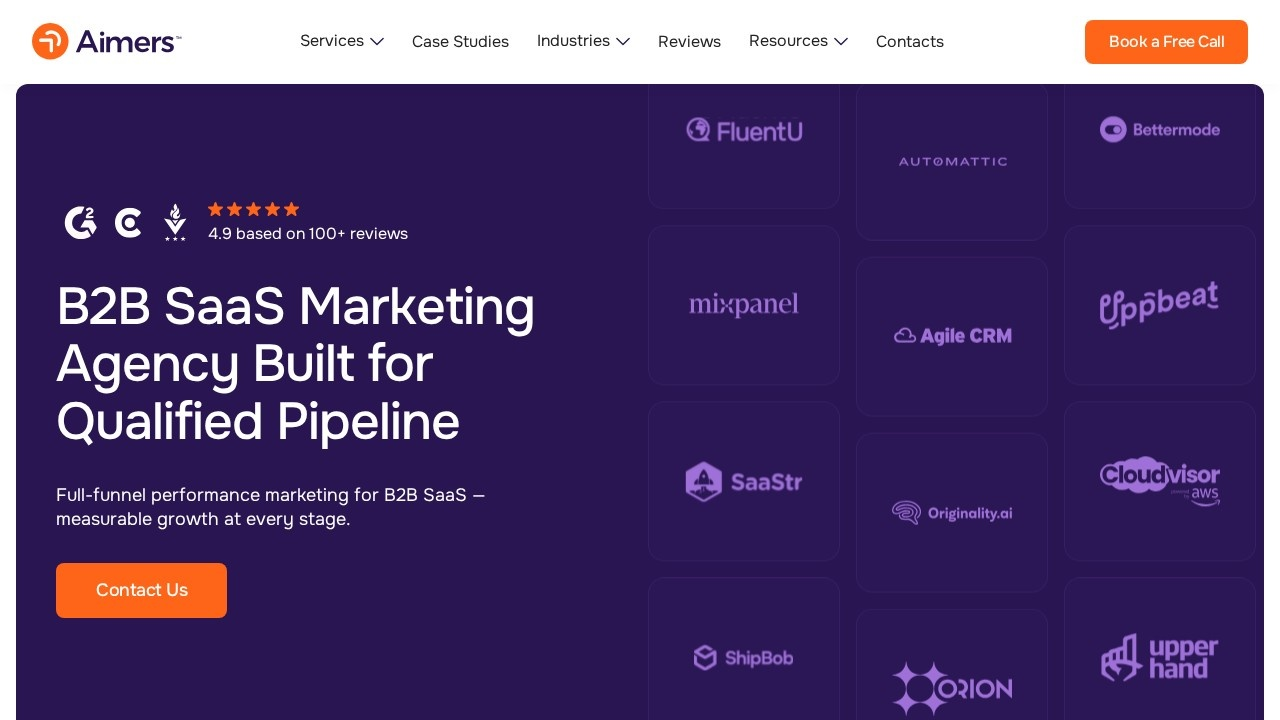
Best for: PLG SaaS companies that need to scale paid acquisition after the funnel is validated.
Aimers is a performance marketing agency for B2B SaaS specializing in full-funnel acquisition. For product-led companies, the fit is strongest when you already understand your activation path, trial-to-paid economics, ICP, and conversion events, and now need to scale paid acquisition without losing CAC discipline.
Aimers is especially useful for PLG companies running a hybrid self-serve and sales-assist motion. Paid campaigns can drive qualified signups, demo requests, product-qualified accounts, or high-intent traffic to product, pricing, comparison, and use-case pages.
Why it fits PLG:
- Strong B2B SaaS paid acquisition focus.
- Useful for PLG companies that need qualified signup volume, not just raw traffic.
- Can support full-funnel paid campaigns tied to signup, demo, or product-qualified lead goals.
- Relevant when the PLG funnel already has enough conversion data to scale responsibly.
Best-fit use cases:
- You know your activation and trial-to-paid benchmarks and want to grow faster.
- You need Google Ads or paid search for high-intent product discovery.
- You want LinkedIn or paid social campaigns for product-led and sales-assist motions.
- You need a specialist PPC partner rather than a broad PLG agency.
Potential limitation: Aimers is not the primary fit for product onboarding, in-app activation, lifecycle email strategy, or product analytics implementation. For those needs, pair paid acquisition with CRO, analytics, or product design support.
2. Powered by Search
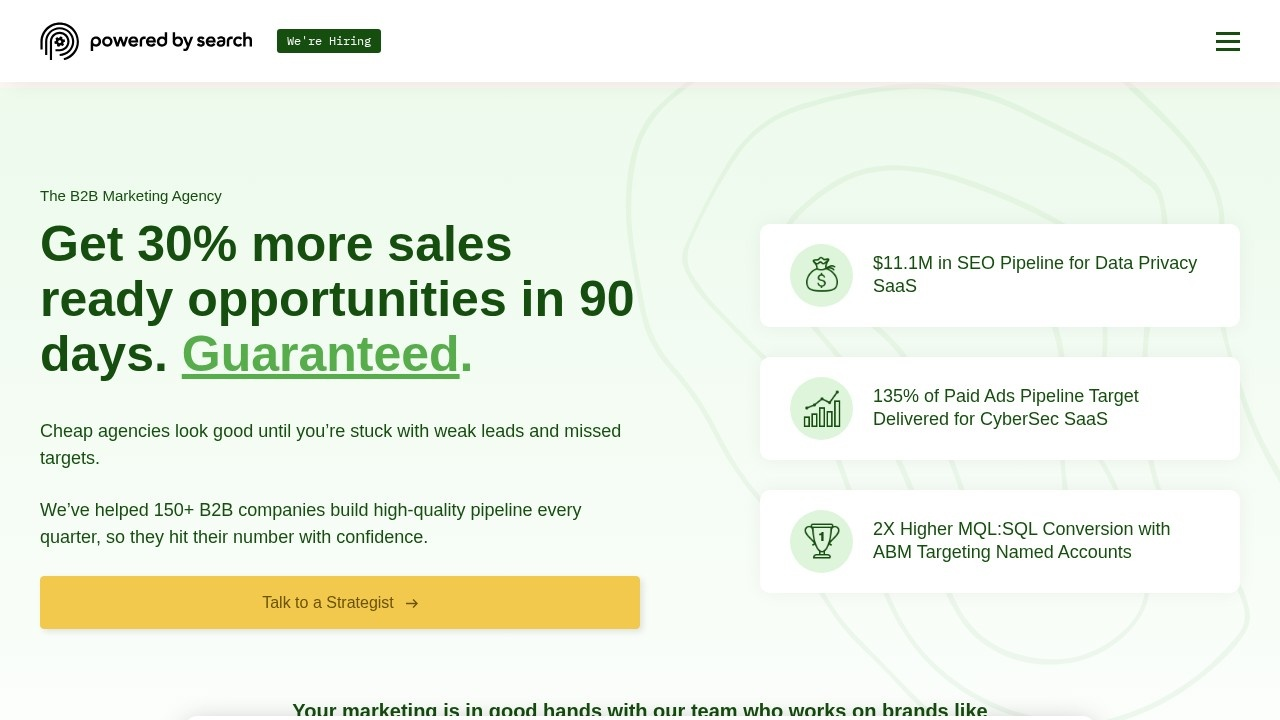
Best for: PLG SaaS companies that need full-funnel demand generation, SEO, PPC, and RevOps support.
Powered by Search is a B2B SaaS marketing agency focused on predictable pipeline growth through demand generation, SEO, PPC, and RevOps. For PLG companies, the strongest fit is usually when acquisition, conversion, and sales-assist need to work together.
This is useful for PLG teams that have moved beyond "get more users" and now need a cleaner growth system: qualified trials, better campaign-to-product messaging, stronger lifecycle handoff, and reporting that connects activity to pipeline.
Why it fits PLG:
- Covers SEO and paid acquisition, which are common PLG entry points.
- Supports RevOps and automation, useful when product-qualified accounts need sales follow-up.
- Can help align demand generation with trial, demo, or freemium conversion paths.
Best-fit use cases:
- You have product-market fit and want to scale acquisition.
- You need SEO and PPC to support the same PLG funnel.
- You need better reporting between marketing, product usage, and pipeline.
- You want one partner across acquisition and revenue operations.
Potential limitation: If your main problem is in-product onboarding or feature adoption, you may still need a product analytics, lifecycle, or product design specialist.
3. GrowthCurve
Best for: PLG companies that need an on-demand growth team across creative, CRO, analytics, lifecycle, and performance.
GrowthCurve positions itself as an on-demand growth team for SaaS, covering strategy, performance, creative, CRO, analytics, and lifecycle in one place. That makes it a strong fit for PLG companies where the bottleneck is not isolated to one channel.
PLG teams often need multiple small experiments running at the same time: landing page tests, activation emails, signup funnel improvements, creative tests, retargeting, and lifecycle nudges. A broad growth team can be useful when the company has enough data and traffic to learn quickly.
Why it fits PLG:
- Combines performance marketing with CRO and lifecycle.
- Useful for teams that need faster experimentation velocity.
- Can support both acquisition and post-signup conversion work.
Best-fit use cases:
- Your trial or freemium funnel has several leaks.
- You need creative, media, analytics, and CRO working together.
- You want a flexible growth partner instead of separate channel vendors.
- Your internal team is small and needs execution capacity.
Potential limitation: A broad partner is only effective if your team can give clear priorities and access to data. Without that, the work can spread too thin.
4. OMNIUS
Best for: PLG SaaS companies that need SEO, content, and LLM visibility tied to product-led search demand.
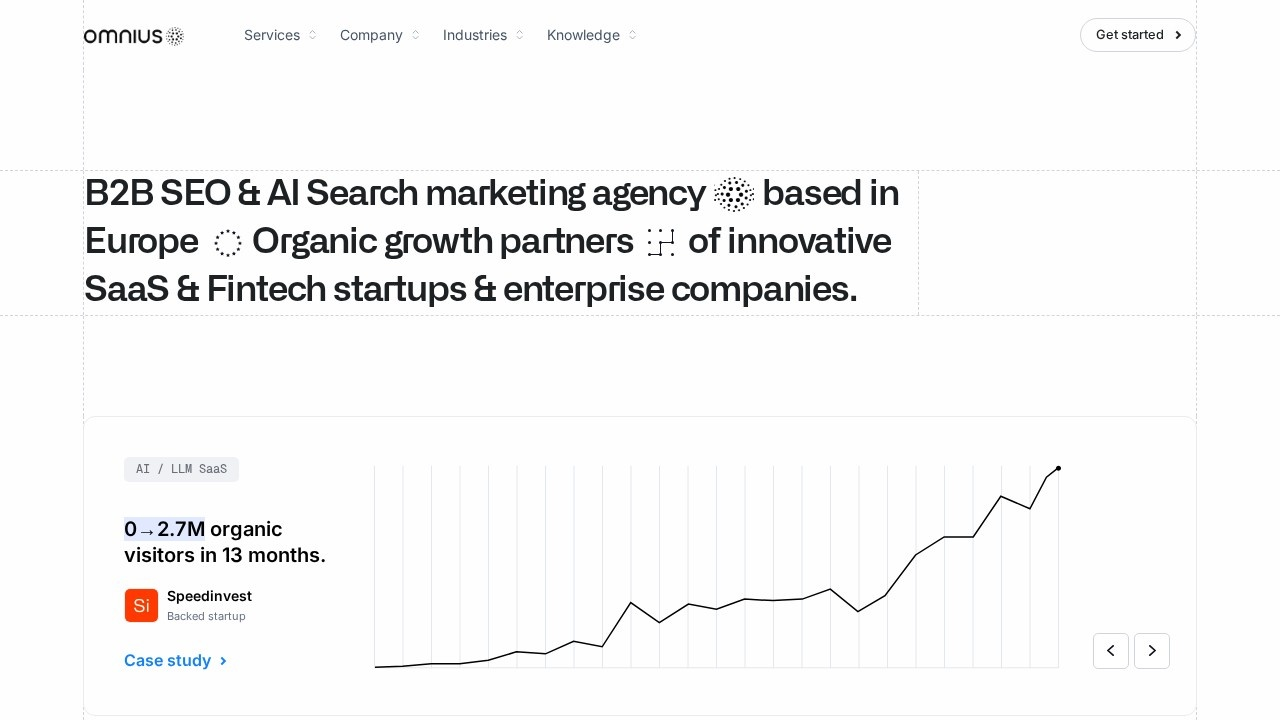
OMNIUS is listed as a B2B SaaS and fintech SEO/content agency focused on product-led growth and LLM visibility optimization. That makes it especially relevant for SaaS companies where organic discovery is tied to use cases, integrations, templates, comparisons, and AI search visibility.
For PLG companies, SEO should not only bring traffic. It should help the right users understand the product, find a use case, reach an activation path, and convert into a signup or sales-assist motion.
Why it fits PLG:
- Strong fit for product-led SEO and content-led acquisition.
- Relevant for SaaS companies investing in AI search and LLM visibility.
- Useful when product pages, comparison pages, and use-case content are part of the growth engine.
Best-fit use cases:
- You want organic acquisition to feed free trials or self-serve signups.
- You need content that explains product use cases clearly.
- You care about GEO, AI Overviews, or LLM discoverability.
- You operate in a technical or competitive SaaS category.
Potential limitation: SEO and content are compounding channels. If you need immediate pipeline this month, pair organic work with paid acquisition or lifecycle improvements.
5. Nine Peaks
Best for: Early-stage PLG SaaS companies that need focused SEO, content strategy, technical SEO, and link building.
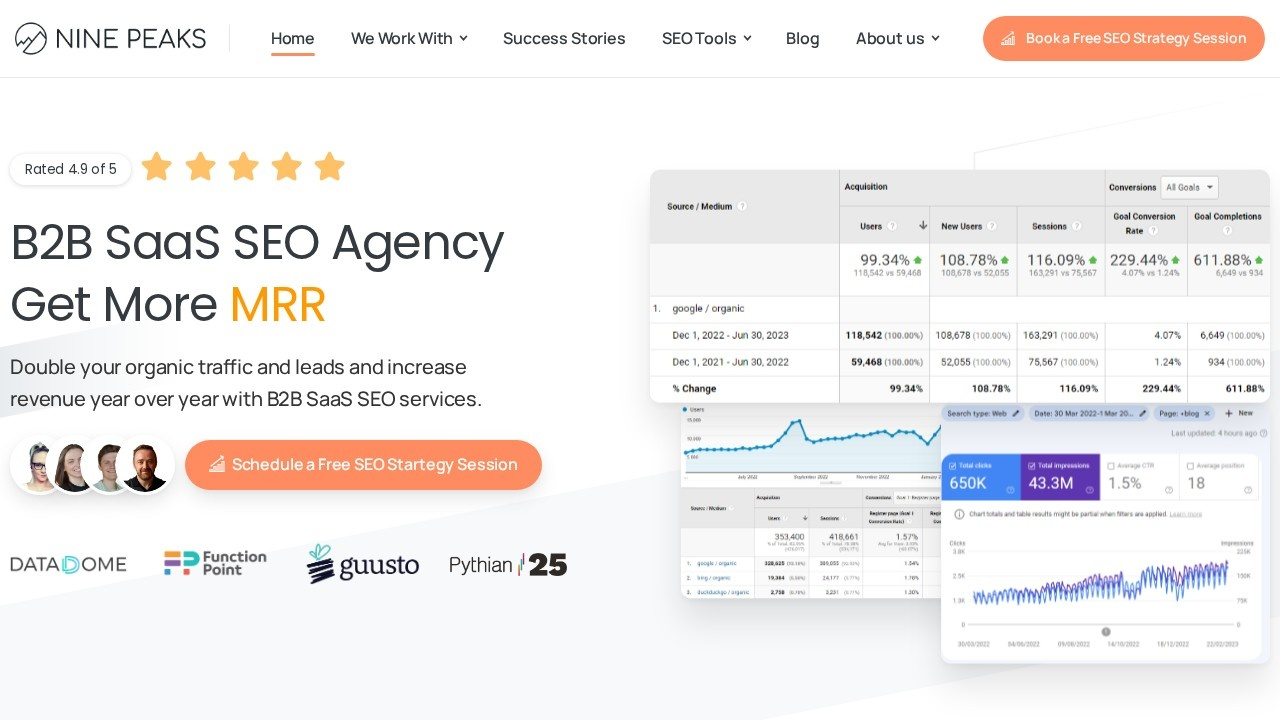
Nine Peaks is a specialized B2B SaaS SEO agency focused on helping companies rank on the first page through content strategy, technical SEO, and link building. For PLG teams, this is a fit when the acquisition motion depends on search visibility and category education.
Nine Peaks is especially relevant for companies that need to build durable organic demand before expanding into a larger multi-channel program.
Why it fits PLG:
- Focused on SaaS SEO rather than broad digital marketing.
- Strong fit for product-led search, use-case pages, and technical SEO foundations.
- Useful for early-stage companies that need organic traction without hiring a full SEO team.
Best-fit use cases:
- You need a focused SEO partner for a lean PLG team.
- Your product has searchable use cases, integrations, alternatives, or workflows.
- You need content strategy and link building to support ranking growth.
- You want an SEO program that supports signup intent, not just traffic volume.
Potential limitation: If your biggest issue is weak trial activation, SEO alone will not solve it. Pair with CRO or onboarding work.
6. BRIX
Best for: PLG companies that need a high-converting SaaS website or product-led marketing site.
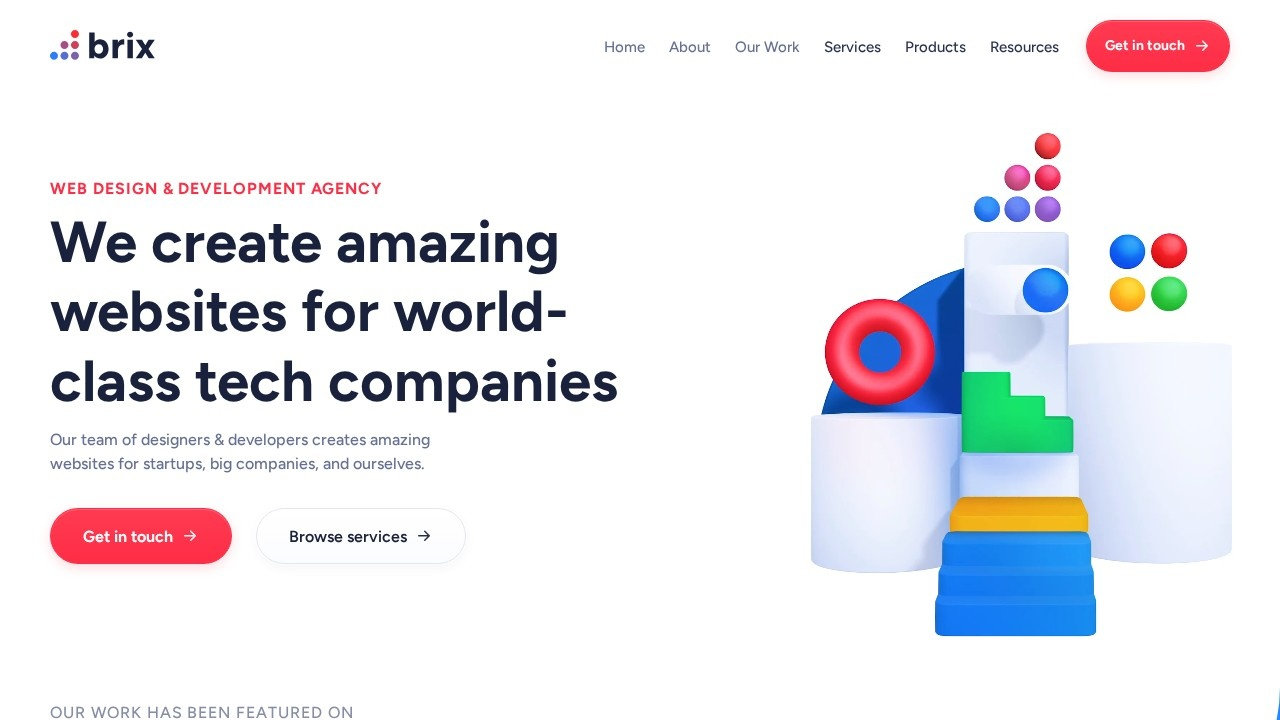
BRIX is a website design and development agency specializing in SaaS websites. For PLG companies, the marketing site is often part of the product experience. It must help users understand the product quickly, compare plans, start a trial, and reach the right activation path.
BRIX is a strong fit when the website is the bottleneck: unclear positioning, weak signup flow, poor page structure, slow performance, or a design system that is hard for marketing to update.
Why it fits PLG:
- Focuses on SaaS website design and development.
- Relevant for conversion-focused landing pages, pricing pages, and product pages.
- Useful for teams that need a polished website before scaling acquisition.
Best-fit use cases:
- You are redesigning a PLG marketing site.
- Your homepage, pricing page, or use-case pages underperform.
- You need a scalable website system for experiments and launches.
- You want design and development in the same partner.
Potential limitation: Website work should be connected to funnel analytics. Before redesigning, define the metrics: signup rate, activation rate, demo requests, plan comparison clicks, or product-qualified accounts.
7. RCCO
Best for: SaaS startups and scale-ups that need website design and conversion optimization.
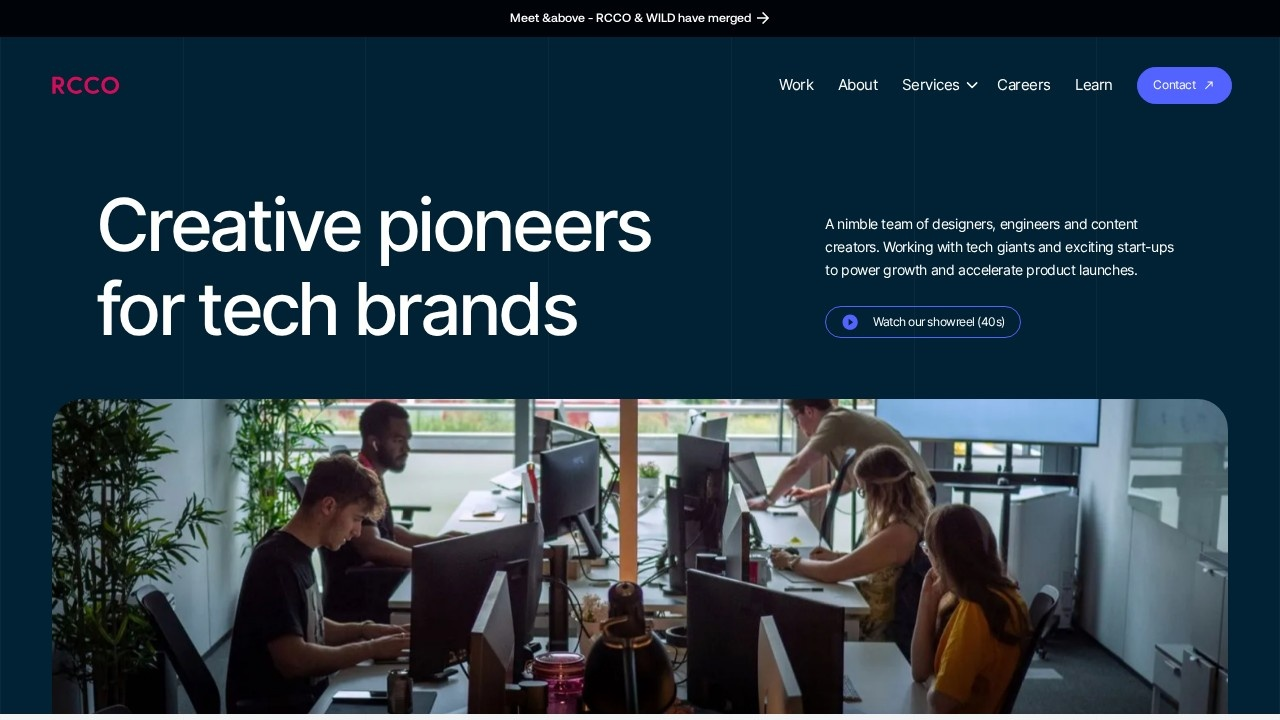
RCCO is a London-based SaaS website design and conversion optimization agency for tech startups and scale-ups. It fits PLG companies that need the website to do more than look credible: it needs to explain product value, reduce friction, and move users toward trial, demo, or account creation.
RCCO is especially relevant when a PLG company has traffic but the website does not convert enough of it into qualified product engagement.
Why it fits PLG:
- Focuses on SaaS website design and conversion.
- Relevant for pricing, landing pages, and high-intent product pages.
- Strong fit when design and CRO need to work together.
Best-fit use cases:
- Your signup conversion rate is below expectations.
- Your pricing page creates confusion.
- Your website does not communicate the product's "aha" moment.
- You need conversion-focused pages for paid or organic traffic.
Potential limitation: Website CRO is strongest when paired with user research and analytics. Make sure testing and measurement are in scope.
8. Afternow
 Best for: Funded startups that need product, design, and development support from discovery through launch.
Afternow is a full-service SaaS design and development agency that helps funded startups and tech SMEs build websites and digital products from discovery through launch. For PLG companies, Afternow is most relevant when the product experience itself needs design and development capacity.
This makes it different from a pure marketing agency. It is more appropriate when the growth problem sits close to product: onboarding UX, product pages, launch experience, user flows, or the first version of a self-serve product motion.
Why it fits PLG:
- Covers design and development, not only marketing execution.
- Useful for product-led teams that need to ship or improve digital experiences.
- Good fit for funded startups that need a structured launch partner.
Best-fit use cases:
- You need to build or improve a self-serve product experience.
- You are launching a new SaaS product, portal, or product-led website.
- Your internal product/design team lacks bandwidth.
- You need execution from discovery to launch.
Potential limitation: If you already have a strong product team and only need acquisition, a marketing or SEO specialist may be a better first hire.
9. LabsMedia
Best for: PLG companies that want a multi-channel SaaS marketing partner across SEO, PPC, content, and demand generation.
LabsMedia is a full-service SaaS marketing agency with experience in SEO, content marketing, PPC, and demand generation. For PLG companies, this can be a fit when growth depends on multiple acquisition channels and the team wants one partner to coordinate them.
LabsMedia is especially relevant for teams that need a practical mix of traffic generation and conversion support, rather than a single-channel specialist.
Why it fits PLG:
- Covers SEO, PPC, content, and demand generation.
- Useful for companies that need both organic and paid acquisition.
- Can support PLG teams that are moving from founder-led marketing to a more structured growth program.
Best-fit use cases:
- You need content, SEO, and paid campaigns under one plan.
- You want to build a predictable acquisition engine.
- You have a product-led funnel but need more qualified users entering it.
- You need practical execution more than high-level strategy decks.
Potential limitation: Ask how the agency measures product-led outcomes. A PLG engagement should report beyond traffic, impressions, and leads.
10. Bay Leaf Digital
Best for: B2B SaaS companies that need full-funnel marketing, content, social, and AI-forward workflows.
Bay Leaf Digital is listed as a full-funnel SaaS marketing agency combining content, social media, and AI-forward workflows for revenue growth. For PLG companies, Bay Leaf Digital is most relevant when marketing needs to support the whole buyer and user journey, not just top-of-funnel acquisition.
This can be a fit for PLG companies that need content, social proof, lifecycle-style messaging, and funnel support around a self-serve or hybrid PLG/sales-assist motion.
Why it fits PLG:
- Full-funnel SaaS marketing orientation.
- Useful for content and social programs that support product education.
- Relevant for teams exploring AI-assisted marketing workflows.
Best-fit use cases:
- You need full-funnel SaaS content and campaign support.
- Your PLG motion needs stronger education and nurture.
- You want marketing workflows that can scale with a small team.
- You need broader revenue support rather than one isolated channel.
Potential limitation: For deep product analytics or onboarding experimentation, confirm whether the agency has that capability in-house or partners with specialists.
How to Choose the Right PLG Agency
Use the bottleneck first. The wrong agency type can make a good PLG motion harder to diagnose.
If acquisition is the problem
Choose a partner with SEO, PPC, content, or demand generation strength.
Good fits: Powered by Search, OMNIUS, Nine Peaks, LabsMedia, Aimers.
Ask:
- Which signup or trial events will you optimize toward?
- How will you distinguish traffic from qualified product users?
- How will campaigns connect to activation, not only conversion?
- What reporting will show CAC, signup quality, and downstream pipeline?
If activation is the problem
Choose a partner with CRO, lifecycle, analytics, onboarding, or UX strength.
Good fits: GrowthCurve, RCCO, Stan Vision, Afternow.
Ask:
- What activation event should we optimize for?
- How will you diagnose friction in the onboarding flow?
- What data access do you need from product analytics tools?
- Will you test messaging, UX, emails, and landing pages together?
If your website is the problem
Choose a SaaS website or conversion partner.
Good fits: BRIX, RCCO, Stan Vision.
Ask:
- How will the website communicate the product's core value?
- Which pages are most important for PLG conversion?
- Will the redesign include pricing, product, use-case, and comparison pages?
- How will we measure success after launch?
If analytics is the problem
Choose an analytics or RevOps partner before hiring a channel agency.
Start with the SaaS marketing analytics agencies category if you cannot answer:
- Which users activate?
- Which channels bring activated users?
- Which product actions predict conversion?
- Which accounts should sales assist?
- Which lifecycle messages improve retention or expansion?
Without those answers, a PLG marketing agency may generate more activity without improving the growth model.
Questions to Ask Before Hiring a PLG Marketing Agency
Before signing a statement of work, ask:
- Which part of the PLG funnel do you improve: acquisition, signup, activation, conversion, retention, or expansion?
- Which metrics do you report weekly?
- Do you need access to product analytics tools such as Amplitude, Mixpanel, PostHog, Heap, or Pendo?
- Can you work with our product, growth, sales, RevOps, and customer success teams?
- Do you optimize for users, accounts, pipeline, revenue, or all of the above?
- What is your process for testing onboarding, landing pages, pricing pages, and lifecycle messages?
- How do you define a qualified signup or product-qualified account?
- What will you need from our internal team in the first 30 days?
- How do you handle experiments when traffic volume is low?
- What should we not hire you for?
The last question is important. Strong agencies know their lane.
FAQ
What is a product led growth agency?
A product led growth agency helps SaaS companies grow by improving the connection between product usage, acquisition, conversion, retention, and expansion. Depending on the agency, this may include SEO, PPC, CRO, onboarding, lifecycle marketing, analytics, website optimization, or product-led content.
How is a PLG marketing agency different from a traditional SaaS marketing agency?
A traditional SaaS marketing agency may focus mainly on leads, demos, campaigns, or pipeline. A PLG marketing agency should also understand signups, activation events, free-to-paid conversion, product-qualified accounts, onboarding, in-app behavior, and lifecycle messaging.
When should a PLG company hire an agency?
A PLG company should hire an agency when it has a clear bottleneck and enough internal ownership to support the work. Common moments include scaling acquisition after product-market fit, fixing weak signup conversion, improving onboarding, building a product-led SEO engine, or connecting product analytics to revenue reporting.
What metrics should a PLG agency report?
A PLG agency should report metrics tied to its scope. Useful metrics include qualified signups, signup conversion rate, activation rate, free-to-paid conversion, product-qualified accounts, CAC, pipeline influenced, retention signals, experiment results, and channel quality by user or account segment.
Should PLG companies hire a full-service agency or a specialist?
Hire a specialist when the bottleneck is clear, such as SEO, CRO, analytics, paid acquisition, or website conversion. Hire a full-service agency when the problem crosses multiple functions and your internal team needs coordinated execution across acquisition, conversion, lifecycle, and reporting.
Is PLG only for self-serve SaaS?
No. Many B2B SaaS companies use hybrid PLG and sales-assist motions. In that model, the product creates usage signals, while sales helps qualified accounts expand, upgrade, or navigate enterprise buying requirements.