

Best SaaS Brand and Messaging Agencies for Repositioning
Repositioning a SaaS company is not the same as changing a logo or rewriting a homepage headline. It is a commercial decision about how the market should understand the product, which buyers the company wants to attract, what category it should compete in, and why the offer is meaningfully different.
That is why the best SaaS brand strategy agencies work across research, positioning, messaging, identity, website experience, and go-to-market rollout. A visual refresh can make a company look newer, but it cannot fix an unclear ICP, a weak category story, or a value proposition that sales cannot defend.
This guide compares SaaS brand and messaging agencies for repositioning projects. It focuses on the type of problem each partner is suited to solve, from customer research and message architecture to brand identity, website redesign, and GTM implementation.
Quick Answer
Choose a SaaS brand and messaging agency based on the reason for repositioning:
| Repositioning problem | Best partner profile | Agencies to compare |
|---|---|---|
| The product is hard to explain to the right buyer | Positioning and messaging strategist | FirstPrinciples Growth, Tiller |
| The company looks generic in a crowded category | Brand strategy and identity partner | Tiller, Ramotion |
| The brand needs a new website and visual system | Brand-led design and web agency | Ramotion, BRICX |
| The marketing team needs strategy plus execution | Full-service SaaS growth partner | Kalungi, FirstPrinciples Growth |
| The story is clear, but paid acquisition is not converting it | Performance and CRO partner after repositioning | Aimers, alongside a brand specialist |
The last row is important. A performance agency can help validate and scale a new message through campaigns and conversion testing, but it should not automatically be treated as a replacement for brand research or category strategy.
What a SaaS Brand Strategy Agency Should Actually Do
A repositioning engagement should create a system that the company can use across the buyer journey. The exact deliverables vary, but the work normally includes several connected layers.
1. Market and customer understanding
The agency should learn how customers describe the problem, what alternatives they consider, which outcomes matter, and why deals are won or lost. Useful evidence may include:
- Customer and prospect interviews.
- Win-loss interviews and sales-call reviews.
- Support conversations and product usage patterns.
- Competitive and alternative analysis.
- Website behavior, search demand, and conversion data.
- Feedback from sales, customer success, product, and leadership.
Research is not valuable because it produces a large report. It is valuable when it changes a decision about the audience, category, offer, or message.
2. Positioning and category choice
Positioning answers how the company should be understood relative to alternatives. It should define the target customer, the problem the company owns, the category or frame it wants to compete in, the differentiated value, and the proof that supports the claim.
A positioning document may include:
- Primary ICP and priority segments.
- Buying committee and decision roles.
- Customer jobs, pains, triggers, and objections.
- Competitive alternatives, including doing nothing.
- Category or narrative recommendation.
- Differentiation and reasons to believe.
- Positioning statement and elevator pitch.
3. Messaging architecture
Messaging translates positioning into language different teams can use. It should not be a collection of slogans. A useful system explains what to say, to whom, in what situation, and with which proof.
Typical outputs include:
- Core narrative and message hierarchy.
- Homepage and product-page messaging.
- Segment-specific value propositions.
- Executive, practitioner, and technical-buyer messages.
- Objection handling and competitive talk tracks.
- Sales deck, one-pager, and demo narrative guidance.
- Guidelines for claims, terminology, and proof.
4. Brand and website rollout
If the repositioning includes a new identity or website, the agency should show how the strategic work will influence the design. The visual system should make the new story easier to recognize and understand, not merely make the company look different.
The rollout may include brand identity, design system, marketing website, product pages, case-study templates, launch assets, and internal enablement. Confirm which parts are strategy, design, copy, development, and implementation because these are often scoped separately.
Best SaaS Brand and Messaging Agencies for Repositioning
The agencies below are listed in the SaaSAgency.org directory and represent different repositioning models. This is a fit-based shortlist, not a universal ranking. Verify current services, team availability, pricing, case studies, and the exact level of research before signing.
1. Tiller: Best for Voice-of-Customer-Led Brand and Demand Repositioning
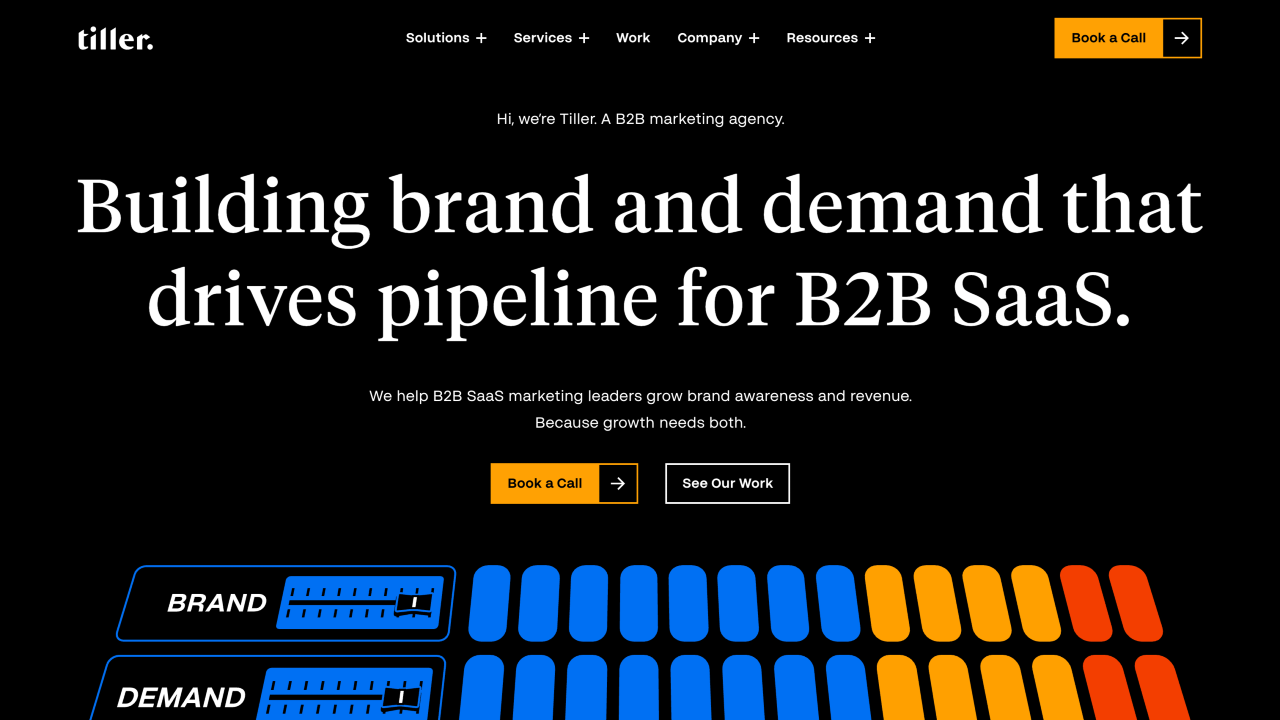
Tiller is a strong fit for SaaS companies that want brand strategy connected to website, demand generation, paid media, CRO, and customer insight. Its directory profile describes branding and positioning, messaging architecture, visual identity, brand guidelines, website design, demand generation, and conversion optimization. The profile also emphasizes Voice of Customer research across the engagement.
Best fit: B2B SaaS companies that need the new brand story to work across both perception and pipeline.
Tiller can make sense when the company is not choosing between “brand” and “demand.” It may need both: a clearer market position, a stronger visual and verbal identity, a website that reflects the new story, and campaigns that turn the repositioning into qualified demand.
Potential strengths for repositioning:
- Customer research connected to messaging decisions.
- Brand and positioning work alongside website and CRO.
- A unified path from identity to demand generation.
- Support for companies that have outgrown an early-stage brand.
Watch for: Make sure the statement of work distinguishes discovery, positioning, messaging architecture, visual identity, website work, campaign execution, and post-launch optimization. A broad full-service scope can be useful, but it can also make it harder to see which strategic decisions will be completed first.
Ask: Which customer evidence will change the message, and how will the new positioning be measured after it reaches the website and campaigns?
2. Ramotion: Best for Brand-Led SaaS Repositioning and Website Experience
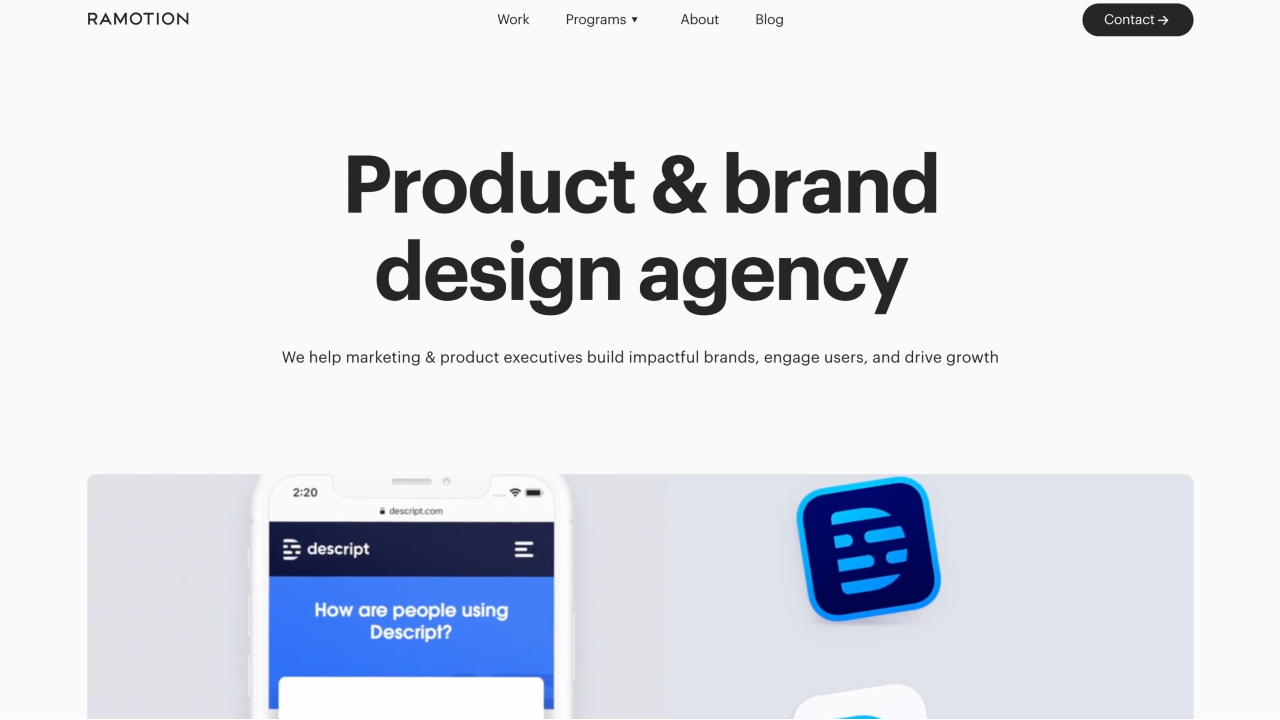
Ramotion is a relevant choice for SaaS companies whose repositioning requires a distinctive identity, stronger design system, and a new marketing website. Its directory profile positions Ramotion around SaaS branding, web design, motion design, UI/UX, and marketing websites for technology companies.
Best fit: Growth-stage SaaS and technology companies that have a complex story or generic market presence and need the brand to communicate more clearly through design and digital experience.
Ramotion is particularly relevant when the current brand feels visually interchangeable, the website does not reflect the maturity of the company, or the product needs stronger storytelling through product walkthroughs, motion, and page structure. It is a brand and design-led option, not a substitute for a specialist PPC, SEO, or RevOps agency.
Potential strengths for repositioning:
- Brand identity and visual differentiation.
- Marketing website and front-end experience.
- Product storytelling, motion, and UI/UX.
- Capacity for larger or more complex design programs.
Watch for: Ask how customer research, category strategy, and verbal messaging will inform the design. A visually impressive identity cannot compensate for a positioning decision that has not been resolved. Also clarify who owns copy, information architecture, technical SEO, redirects, analytics, and post-launch conversion testing.
Ask: What strategic message will the design system make easier to understand, and how will the new site be evaluated beyond visual quality?
3. FirstPrinciples Growth: Best for Positioning, Messaging, and GTM Alignment
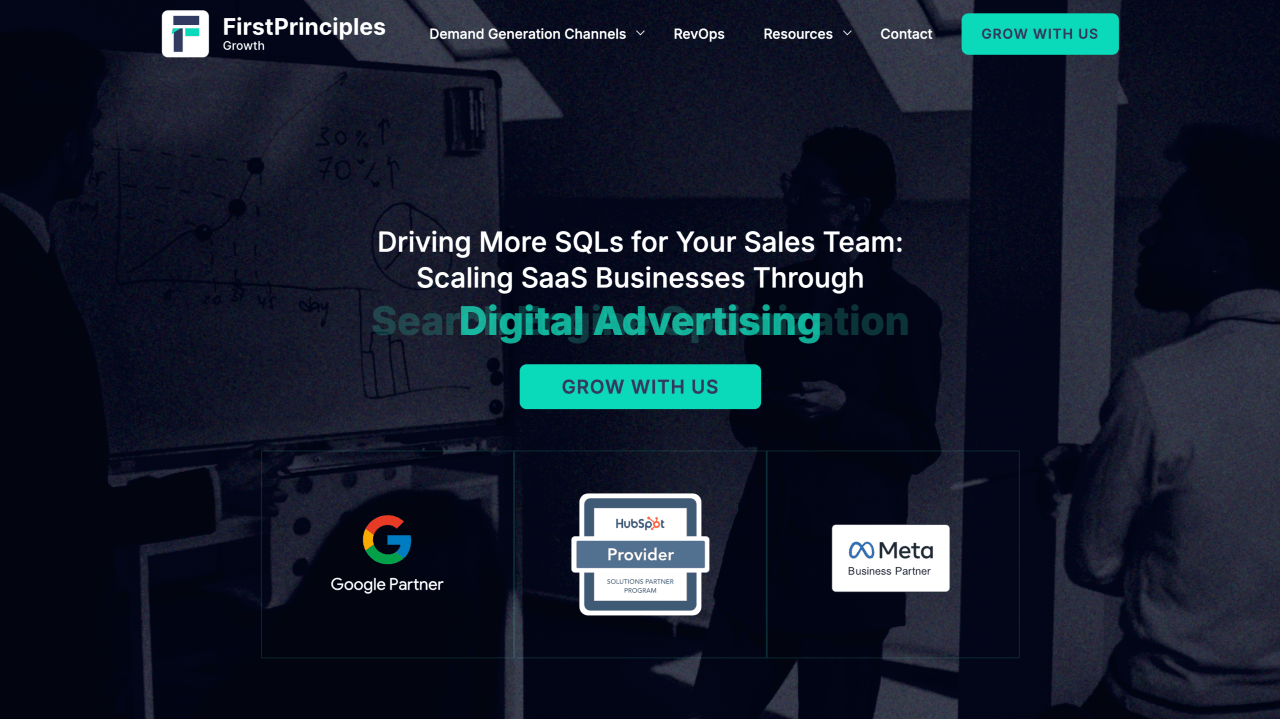
FirstPrinciples Growth is one of the clearest directory fits for SaaS teams that need product marketing and GTM strategy alongside broader growth work. Its profile describes messaging workshops, positioning definition, go-to-market planning, sales enablement content, SEO, content, social advertising, and RevOps.
Best fit: Sales-led B2B SaaS companies that need a sharper market narrative and a practical system for using it across marketing, sales, and revenue operations.
FirstPrinciples Growth is a useful comparison when repositioning is not just a brand exercise. The company may be changing its target segment, entering a new category, rebuilding its sales narrative, or aligning acquisition and enablement around a new commercial direction.
Potential strengths for repositioning:
- Messaging workshops and positioning definition.
- Go-to-market planning connected to execution.
- Sales enablement and revenue-operations alignment.
- A longer-term growth roadmap rather than a one-off launch asset.
Watch for: Clarify whether the engagement includes deep customer research, verbal identity, visual identity, or website production. FirstPrinciples Growth may be a strong strategy and GTM partner, but a brand identity project may still require a specialist design team.
Ask: Which positioning decisions will be made in the first phase, and how will sales, content, paid channels, and RevOps adopt the new message afterward?
4. Kalungi: Best for Early-Stage SaaS Teams That Need Marketing Leadership
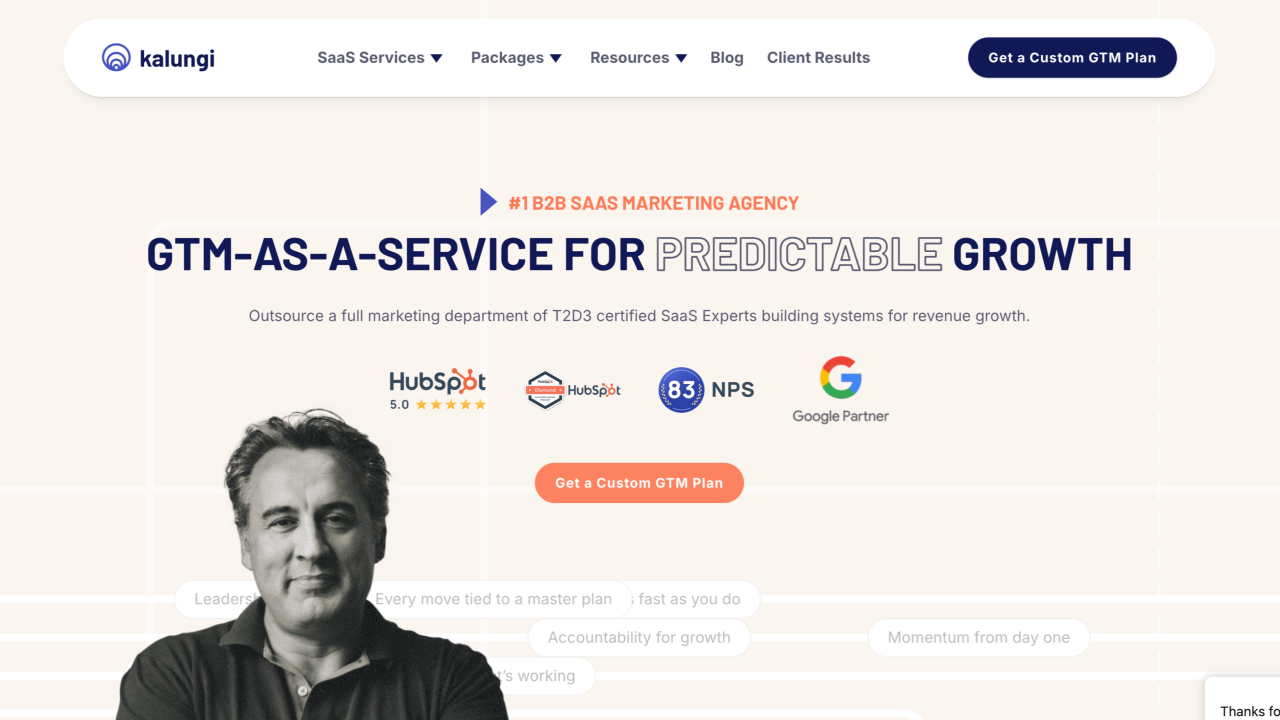
Kalungi is a useful option for early-stage and growth-stage SaaS companies that need repositioning inside a wider marketing operating model. The directory positions Kalungi around fractional CMO support, full-service B2B SaaS marketing, demand generation, content, SEO/SEM, design, analytics, and revenue attribution.
Best fit: Seed to Series B SaaS teams where the brand problem is connected to unclear ICP, weak GTM ownership, inconsistent campaigns, and limited internal marketing leadership.
For these companies, a brand repositioning project often cannot be isolated from the rest of the go-to-market system. The team may need to decide which segment to prioritize, how to explain the product, what campaigns to run, how sales should follow up, and which metrics leadership should track. A fractional marketing leadership model can help coordinate those decisions.
Potential strengths for repositioning:
- Strategy and execution in one broader SaaS marketing model.
- Support for ICP, GTM, content, demand generation, and reporting.
- A possible fit for founder-led teams without senior marketing ownership.
- Connection between message, campaigns, and pipeline measurement.
Watch for: Do not assume that a full-service SaaS marketing scope includes a complete brand strategy or identity system. Ask for the exact positioning, messaging, design, and implementation deliverables, as well as the senior time allocated to the work.
Ask: Who owns the repositioning decision, who facilitates the research, and what will the internal team be able to use after the first 90 days?
5. BRICX: Best for Early-Stage SaaS Product Story and Design Clarity
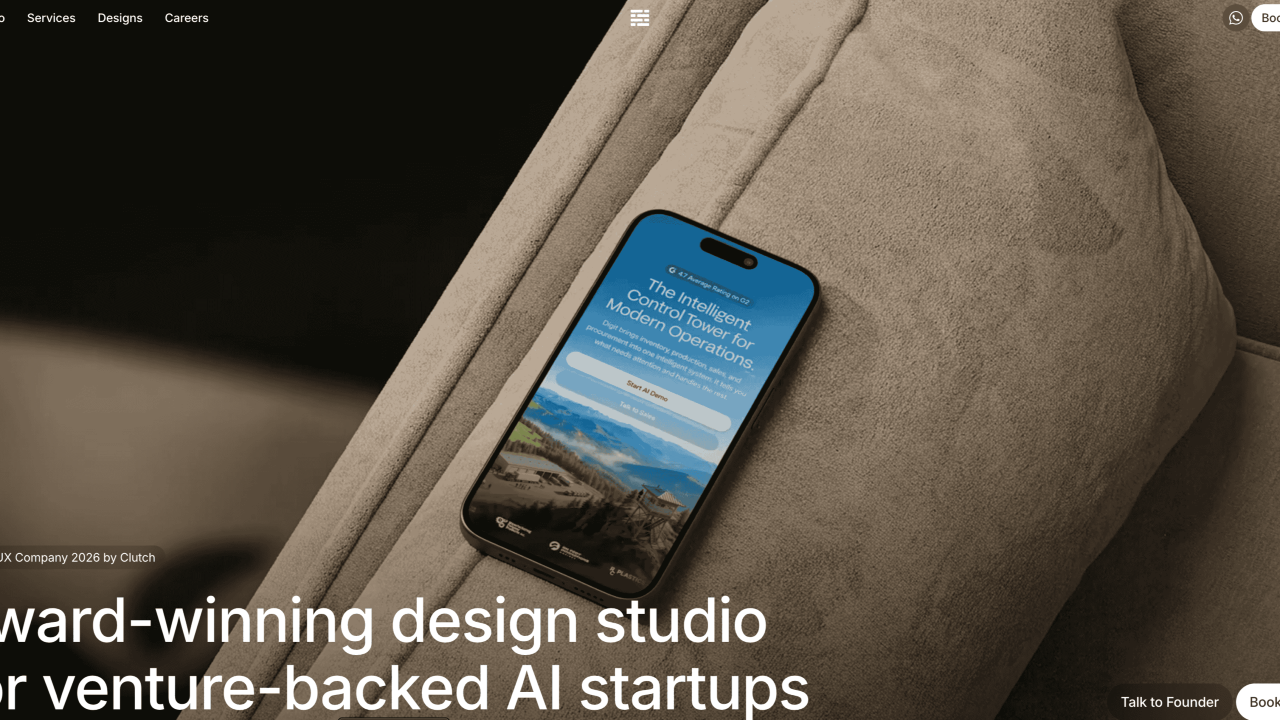
BRICX is an adjacent fit for early-stage SaaS and AI companies where repositioning is closely connected to product design, user experience, website clarity, and conversion. Its directory profile focuses on UI/UX, MVP and product design, design systems, websites, landing pages, and product funnels.
Best fit: Early-stage teams whose product is still evolving and whose market story needs to become clearer through the product, website, and user experience together.
BRICX should not be treated as a classic category-positioning consultancy based only on its design profile. It belongs in the comparison when the repositioning challenge is partly experiential: buyers do not understand the product, the website and product interface tell different stories, or the company needs a coherent design system before scaling.
Potential strengths for repositioning:
- Product and website experience for SaaS and AI products.
- Design systems that keep the new story consistent.
- Landing pages and marketing collateral for early-stage teams.
- A connection between awareness, activation, and product adoption.
Watch for: Make the strategic messaging scope explicit. Confirm who will define the ICP, conduct interviews, write the message architecture, and validate the new story with buyers. Design can clarify a message, but it should not be asked to invent one without evidence.
Ask: What positioning inputs will the design team receive, and how will the agency test whether the new product story is understood by the intended buyer?
Quick Comparison
| Agency | Best fit | Core repositioning strength | Confirm before signing |
|---|---|---|---|
| Tiller | B2B SaaS teams linking brand and demand | Voice-of-Customer-led branding, messaging, web, and CRO | Exact research, identity, campaign, and optimization scope |
| Ramotion | Growth-stage companies needing a distinctive digital brand | SaaS branding, website, motion, and UI/UX | Verbal strategy, copy ownership, SEO migration, and measurement |
| FirstPrinciples Growth | Sales-led SaaS teams aligning positioning and GTM | Messaging workshops, positioning, GTM, and sales enablement | Brand identity depth and customer-research process |
| Kalungi | Early-stage teams needing leadership plus execution | Fractional CMO model and broader SaaS marketing system | Who owns brand strategy and the senior time included |
| BRICX | Early-stage SaaS and AI products needing product-story clarity | Product design, website, design systems, and activation experience | Positioning research, messaging architecture, and buyer validation |
When Should a SaaS Company Reposition?
Repositioning is worth considering when the current market story creates a measurable commercial problem. Common signals include:
- The company sells to a different buyer than the one described on the website.
- Sales teams use different explanations of the product.
- The category has changed, but the company still uses an outdated frame.
- The product has expanded and the original message now feels too narrow.
- The company is attracting traffic or leads that do not fit the ICP.
- Competitors are easier to understand, even when the product is not stronger.
- The website lists features but does not explain business outcomes.
- A rebrand is being discussed without agreement on the target market or value proposition.
Do not start with a visual refresh simply because the website feels old. First determine whether the underlying problem is positioning, messaging, brand expression, information architecture, conversion, or acquisition. Different problems require different partners.
What to Include in a Repositioning Brief
Give every agency the same context so proposals can be compared fairly. A useful brief should include:
Business context
- Product, market, revenue model, and growth stage.
- Current ICP and priority segments.
- Sales motion, ACV, sales cycle, and buying committee.
- Main growth objective for the next 6 to 12 months.
Current brand problem
- What buyers misunderstand today.
- Where sales and marketing language diverge.
- Which segments or use cases are becoming more important.
- What the current brand gets right and what should be preserved.
Evidence available
- Customer interviews, reviews, and testimonials.
- Win-loss notes and sales-call recordings.
- Website analytics and conversion data.
- Product usage and activation data.
- Competitive pages, sales decks, and market research.
Expected outputs
- Research findings and evidence log.
- ICP and segment recommendations.
- Positioning statement and category recommendation.
- Messaging architecture and proof-point framework.
- Brand narrative, verbal identity, or visual identity.
- Website messaging, information architecture, and design system.
- Sales enablement and launch rollout.
- Measurement plan and post-launch ownership.
How to Evaluate Proposals
Do not compare proposals by the number of deliverables alone. Evaluate the logic connecting the work to the business problem.
Research quality
Ask whose voices will be included. A proposal based only on founder interviews and competitor websites is usually too shallow for a serious repositioning. Customers, lost prospects, sales, success, support, and product teams may all reveal different parts of the problem.
Strategic clarity
The agency should explain which decision the engagement will help the company make. “Refresh the brand” is not a sufficiently precise outcome. Better examples include choosing a priority segment, defining a category narrative, replacing feature-led messaging, or creating a message system for an enterprise buying committee.
Adoption plan
Ask how the new positioning will reach the people who use it. A strategy that ends in a PDF may be difficult to operationalize. Look for website copy, sales enablement, campaign guidance, internal training, launch governance, and a process for handling new proof and objections.
Measurement
Brand work should not be reduced to immediate last-click ROI, but it should still have observable signals. Depending on the project, measure:
- Message comprehension in customer or prospect research.
- Qualified engagement from priority segments.
- Conversion rate on repositioned pages.
- Sales adoption of the new narrative and enablement.
- Quality of demos, trials, and opportunities.
- Win rate, sales-cycle friction, and objection patterns.
- Branded search, direct traffic, and category demand over time.
Final Takeaway
The best SaaS brand and messaging agency is not necessarily the one with the most impressive visual portfolio or the broadest service list. It is the partner that can explain what is wrong with the current market story, show which evidence supports the change, and help the company use the new positioning everywhere buyers encounter it.
For customer-insight-led brand and demand work, compare Tiller. For brand-led design and website repositioning, compare Ramotion. For positioning connected to GTM and sales enablement, review FirstPrinciples Growth. For a broader fractional marketing system, consider Kalungi. For early-stage product and website story clarity, BRICX may be relevant.
Browse the SaaS agencies directory and review each agency's current profile, scope, proof, and fit before making a shortlist.
FAQ
What does a SaaS brand strategy agency do?
A SaaS brand strategy agency helps a software company clarify its audience, category, positioning, messaging, differentiation, and brand expression. Depending on the scope, it may also support website design, sales enablement, launch planning, and campaign rollout.
What is the difference between a SaaS branding agency and a messaging agency?
A branding agency may focus on brand strategy, identity, visual systems, websites, and market expression. A messaging agency focuses more heavily on buyer research, positioning, value propositions, narrative, proof, and language. Some SaaS partners combine both; others specialize in one layer.
How much does SaaS repositioning cost?
The cost depends on research depth, the number of markets and segments, brand identity requirements, website scope, stakeholder complexity, and implementation. A focused messaging sprint is materially different from a full rebrand, website redesign, and GTM rollout. Compare proposals by the decisions and outputs included, not just the total fee.
Should a SaaS company rebrand before finding product-market fit?
Usually, early-stage teams should avoid an expensive identity program before they have enough evidence about their ICP, use case, and value proposition. A focused positioning and messaging engagement may be more appropriate first. A larger rebrand makes more sense when the company has a clear reason to change the market story and enough evidence to guide the change.
Can a performance marketing agency handle SaaS repositioning?
Some can contribute valuable channel and conversion evidence, especially when the new message needs to be tested in paid campaigns. However, companies should confirm whether the agency has real capability in customer research, category strategy, verbal identity, and brand systems. Performance execution and brand repositioning are related but not interchangeable disciplines.