
Product marketing is often the missing layer between a good SaaS product and a campaign that buyers understand. If the category is crowded, the launch message is vague, or sales keeps rewriting the same pitch, a product marketing agency can help turn product knowledge into a market-facing system.
The best SaaS product marketing agencies do more than write launch copy. They connect positioning, audience research, messaging, go-to-market planning, sales enablement, and launch execution. The right partner depends on whether the company needs a sharper category story, a repeatable launch process, or hands-on support across the whole motion.
Quick Answer
SaaS product marketing agencies typically help with:
- ICP and buyer research.
- Category, positioning, and differentiation.
- Messaging architecture and value propositions.
- Product launches and go-to-market plans.
- Sales decks, battlecards, one-pagers, and enablement.
- Competitive intelligence and win-loss insight.
- Website, campaign, and lifecycle message alignment.
Use a specialist when the product is strong but the market story is unclear. Use a broader agency when positioning is only one part of a launch that also needs campaigns, content, paid acquisition, or reporting.
What to Look for in a SaaS Product Marketing Agency
Positioning before promotion
A credible partner should be able to explain who the product is for, what problem it solves, what alternatives buyers consider, and why the product is meaningfully different. This should appear in a positioning document, not only in a discovery-call presentation.
Ask for outputs such as:
- ICP and segment definitions.
- Buyer jobs, pains, objections, and triggers.
- Competitive and alternative analysis.
- Category or narrative recommendation.
- Positioning statement and proof points.
- Message hierarchy for each important audience.
Positioning is not a tagline exercise. It is the logic that should make the website, sales conversation, launch brief, and campaign claims agree.
Launch planning that includes adoption
A product launch is not complete when the announcement is published. The agency should define the audience, reason to care, launch stages, channels, owners, enablement, and follow-up measurement.
A practical launch plan may include:
- Internal readiness for sales, support, success, and partners.
- A pre-launch phase for research, beta proof, and audience building.
- Launch assets such as product pages, email, paid media, webinars, and demos.
- A post-launch phase for adoption, objections, and message refinement.
- A measurement plan for reach, qualified engagement, activation, pipeline, and expansion.
Evidence, not invented differentiation
The agency should request customer interviews, win-loss feedback, sales-call language, product usage data, support themes, and competitive evidence. If the team makes a claim about speed, accuracy, savings, or risk reduction, the claim needs proof.
For launches in regulated or technical categories, ask how claims are reviewed and how the agency handles security, compliance, and product limitations.
Best SaaS Product Marketing Agencies to Compare
There is no universal ranking of product marketing agencies. The right choice depends on whether you need positioning research, a go-to-market plan, sales enablement, launch execution, or a partner that can turn the new narrative into measurable demand.
The shortlist below is based on agencies listed in the SaaSAgency.org directory and their publicly described capabilities. It is organized by practical fit, not by a claim that one agency is best for every SaaS company. Confirm current scope, team availability, pricing, and relevant case studies before signing.
1. Aimers: Product Positioning Connected to Paid Growth
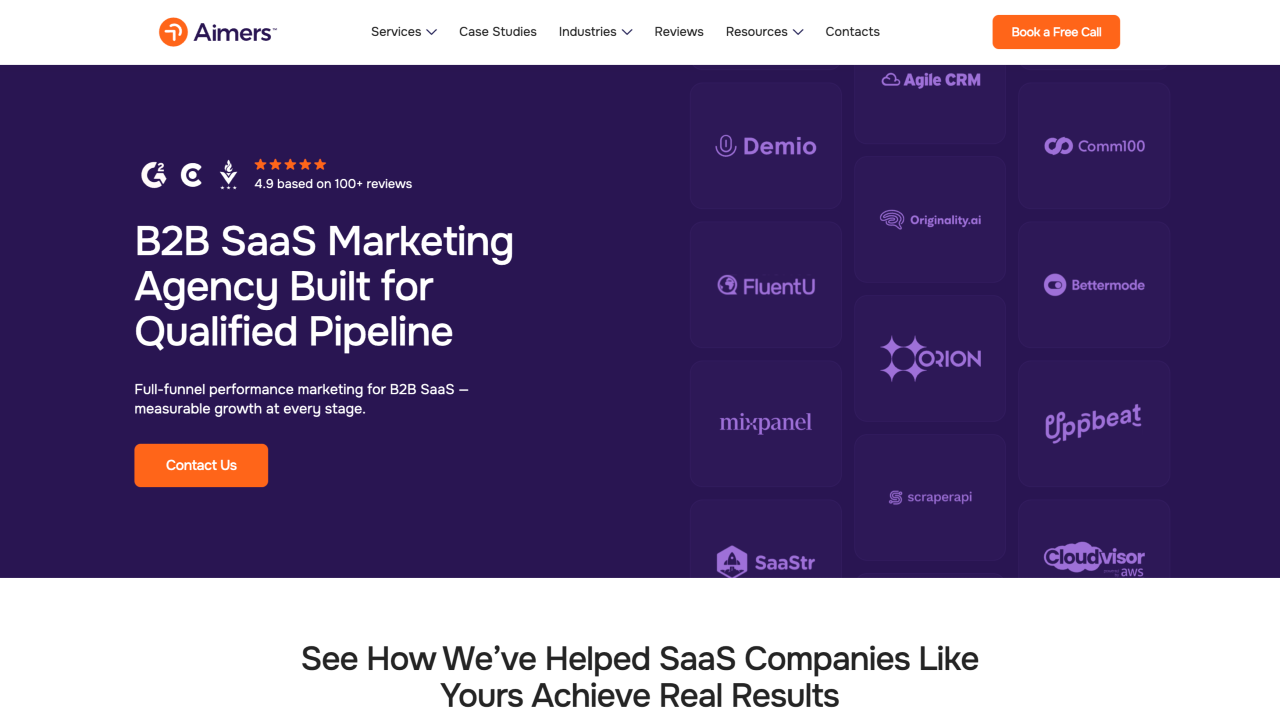
Aimers is a strong option to compare when product positioning needs to translate into paid acquisition, landing pages, CRO, and measurable pipeline. This is especially relevant when a launch needs not only messaging, but also rapid testing of audiences, offers, pages, and conversion paths.
Best fit: B2B SaaS teams with a defined ICP that need the product story to show up consistently in campaigns, ad creative, landing-page copy, conversion paths, and performance reporting.
Where Aimers can be especially useful:
- Turning positioning decisions into Google Ads, LinkedIn Ads, and paid-social angles.
- Testing value propositions and proof points on landing pages.
- Connecting launch campaigns to conversion tracking, CRM stages, and pipeline reporting.
- Giving a marketing team fast feedback on which message attracts qualified demand.
Aimers is not the obvious choice when the main problem is long-form market research or a complete brand repositioning before any acquisition work begins. It becomes more compelling when the company already understands its market reasonably well and needs the message to perform in-market.
Ask before signing: Which parts of the positioning will Aimers own, which assets will it produce, and how will message tests be connected to qualified pipeline rather than only click-through rate or lead volume?
2. FirstPrinciples Growth: Product Marketing and GTM Strategy in a Broader Growth System
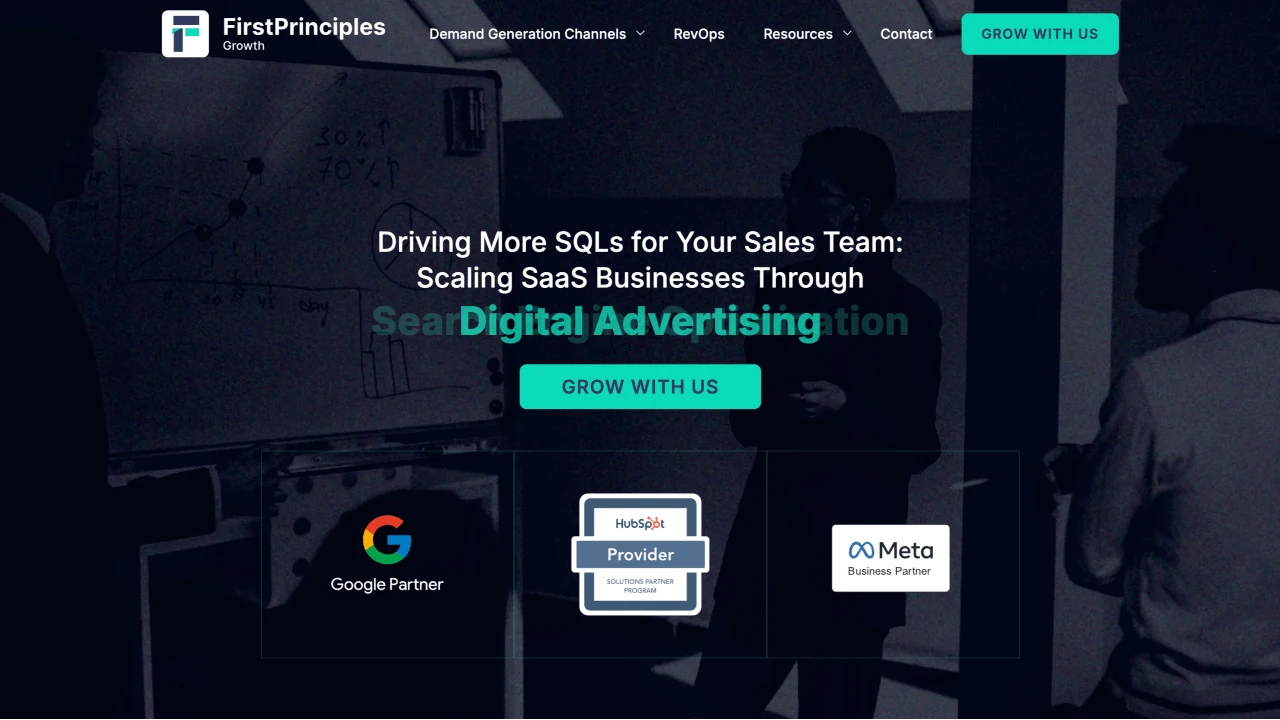
FirstPrinciples Growth is one of the clearest directory fits for SaaS companies looking for product marketing and strategy alongside SEO, content, social advertising, RevOps, and sales enablement. Its profile describes messaging workshops, positioning definition, go-to-market planning, and enablement content tied to contract conversion.
Best fit: B2B SaaS teams that need product marketing to connect with a longer-term growth roadmap instead of operating as a standalone launch project.
Where the model may fit:
- Defining positioning while the company is still refining its category or target segment.
- Aligning product marketing with content, demand generation, RevOps, and sales enablement.
- Building a longer-term GTM system rather than producing a one-off launch announcement.
- Supporting a sales-led motion where messaging must survive across marketing, sales, and revenue operations.
The trade-off is scope. A broader strategic engagement may be more than a team needs for a single feature launch or a tightly bounded messaging sprint. Ask whether the proposed roadmap starts with a focused positioning decision or expands immediately into a large multi-channel program.
Ask before signing: What evidence will shape the positioning recommendation, which senior team members will lead the work, and what will be delivered in the first 30, 60, and 90 days?
3. Kalungi: Fractional Marketing Leadership Plus GTM Execution
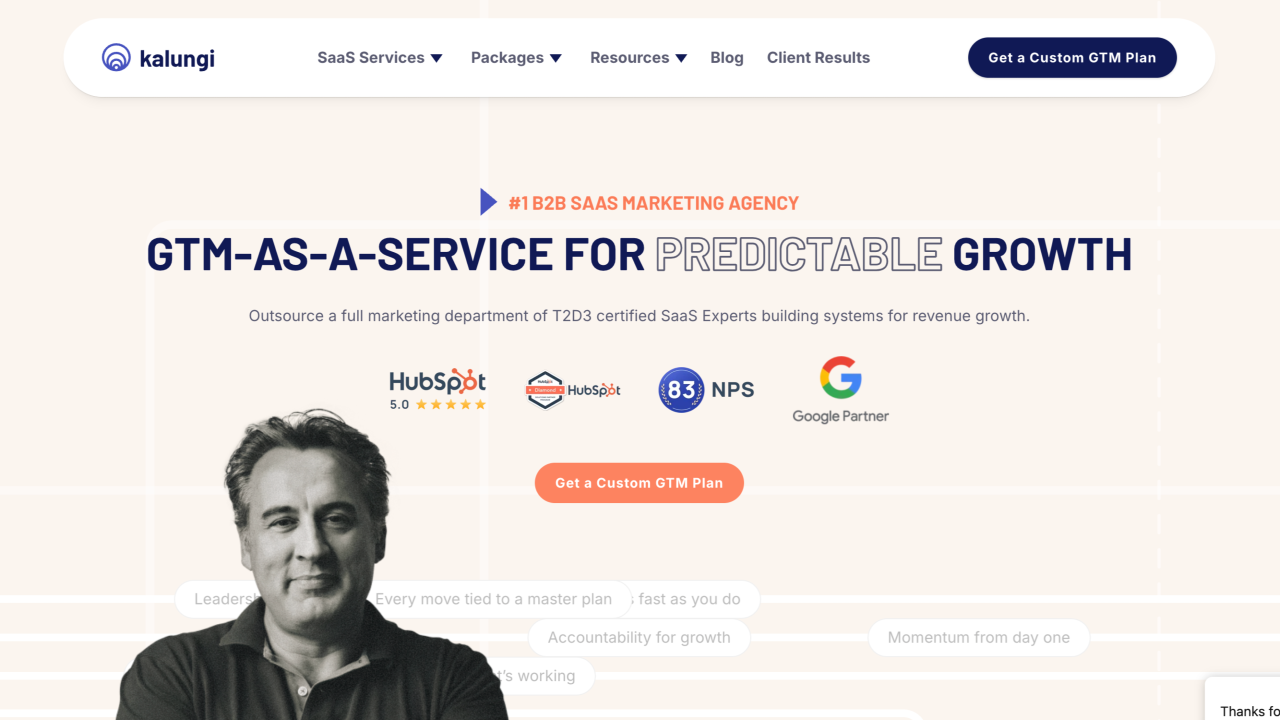
Kalungi is a useful comparison for early-stage and growth-stage SaaS companies that need product marketing inside a wider outsourced marketing function. The directory positions Kalungi around fractional CMO support, B2B SaaS marketing, demand generation, content, SEO/SEM, analytics, and pipeline attribution.
Best fit: Seed to Series B teams that need leadership, planning, execution, reporting, and cross-functional marketing support rather than a narrow product marketing deliverable.
Where the model may fit:
- Creating a repeatable GTM process when the founder is still the main marketing decision-maker.
- Connecting positioning to content, campaigns, sales alignment, and reporting.
- Establishing the operating rhythm around launches, pipeline reviews, and marketing priorities.
- Supporting companies that do not yet have an experienced in-house marketing leader.
Kalungi may be less suitable for a company with a strong VP Marketing that only wants a specialist to run customer interviews and write a positioning narrative. In that case, a focused product marketing consultant or specialist may be faster and more economical.
Ask before signing: Who will act as the fractional CMO, who will do the hands-on product marketing work, how much senior time is included, and how will responsibilities be split between the agency, product team, and sales team?
4. ONEGTMLAB: Positioning as Part of GTM Engineering and ABM
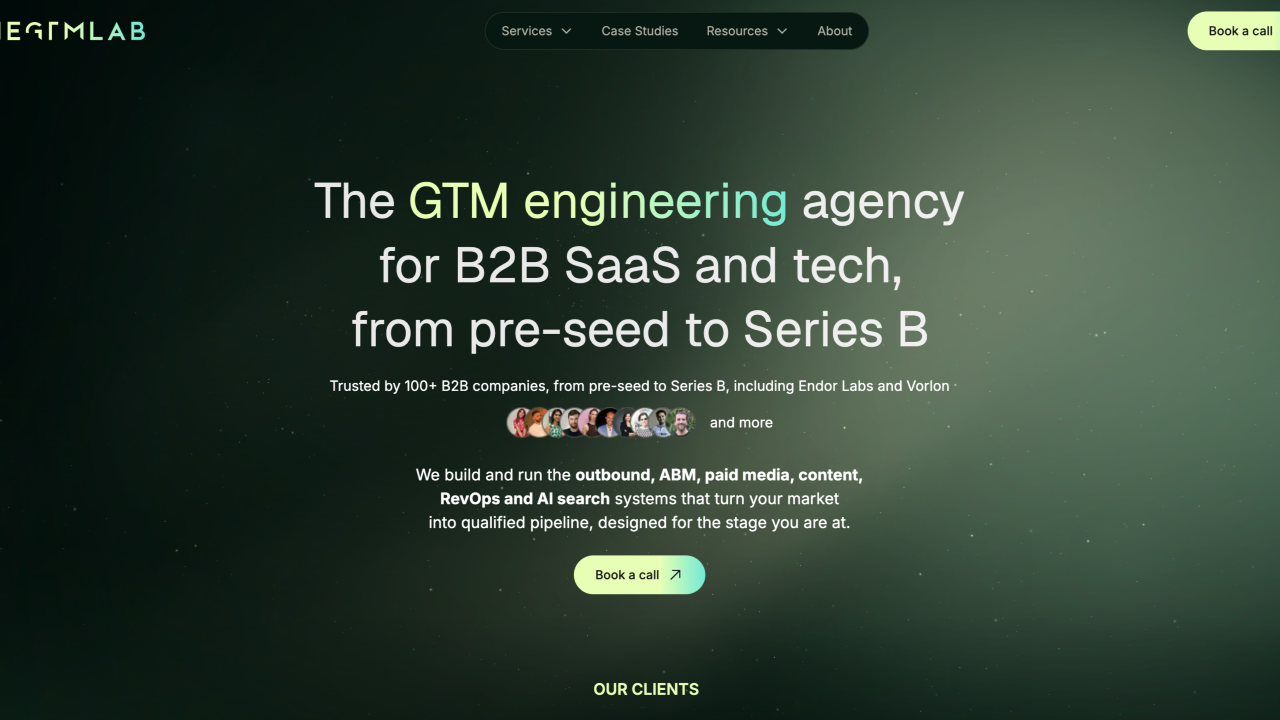
ONEGTMLAB is a relevant option for B2B SaaS and AI startups that want positioning connected to GTM engineering, account-based marketing, paid media, content, RevOps, SEO, and AI-oriented workflows. Its directory profile frames the company as a GTM strategy and execution team rather than a traditional launch-only product marketing shop.
Best fit: Technical or complex B2B products where the launch depends on audience definition, account selection, outbound and inbound coordination, sales alignment, and operational follow-through.
Where the model may fit:
- Building an ICP and account strategy for an enterprise or sales-led launch.
- Connecting positioning to ABM campaigns and sales development workflows.
- Turning product and market insight into content, paid media, SEO, and RevOps execution.
- Creating repeatable GTM workflows for a lean team using automation.
The main question is whether the engagement needs classic product marketing depth or a broader GTM operating layer. If the priority is a detailed category narrative, customer research program, and sales-ready messaging architecture, make those deliverables explicit instead of assuming they are included in a general GTM scope.
Ask before signing: Which product marketing artifacts will be delivered, how will the agency validate the message with buyers, and how will ABM or automation work be kept consistent with the approved positioning?
Quick Comparison
| Agency | Best fit | Strongest reason to compare | Confirm before signing |
|---|---|---|---|
| Aimers | Defined B2B SaaS ICP and performance-led launch | Positioning translated into paid acquisition, CRO, and pipeline | Depth of research and exact PMM scope |
| FirstPrinciples Growth | SaaS teams building a longer-term GTM system | Product marketing connected to RevOps, content, paid, and enablement | Roadmap size, senior involvement, and first-phase outputs |
| Kalungi | Early-stage teams needing leadership plus execution | Fractional CMO model and broad SaaS marketing support | Day-to-day owner, product marketing depth, and internal responsibilities |
| ONEGTMLAB | Technical, enterprise, or ABM-led launches | Positioning connected to GTM engineering and account execution | Buyer research, messaging artifacts, and automation boundaries |
Use this table as a starting point, not a final score. A company can be an excellent acquisition partner and still be the wrong choice for a category-repositioning project. Conversely, a strategic product marketing team may create a strong narrative but not have the capacity to build and optimize the campaign that follows.
How We Built This Shortlist
For a useful product marketing listicle, the inclusion standard should be more demanding than “the agency mentions SaaS.” We looked for directory profiles with at least one clear signal across positioning, product marketing, go-to-market strategy, sales enablement, demand generation, RevOps, or launch execution.
The list should be refreshed as agency services change. Before relying on any comparison, check:
- Whether the relevant service is still offered.
- Whether the agency has worked with a similar SaaS sales motion and ACV.
- Whether the named team can support the engagement now.
- Whether the case studies show adoption or revenue impact, not only completed assets.
- Whether implementation is included or the agency delivers recommendations only.
This matters because “product marketing agency” can describe very different models: a positioning consultancy, a fractional marketing team, a GTM execution partner, a launch studio, or a performance agency that translates messaging into campaigns. Buyers should compare like with like.
How to Choose by Launch Type
| Situation | Best partner profile | First deliverable |
|---|---|---|
| New category or unclear differentiation | Product marketing specialist | Research-backed positioning and message architecture |
| New feature for an established product | Product marketing plus lifecycle support | Launch brief, enablement, and adoption plan |
| Launch needs paid demand immediately | Product marketing plus performance team | Message-to-campaign and landing-page test plan |
| Enterprise launch with many stakeholders | Senior-led B2B partner | Governance, stakeholder map, proof, and rollout plan |
| PLG launch with an activation goal | Product marketing plus growth expertise | In-product, lifecycle, and conversion journey plan |
Questions to Ask Before You Sign
- Which customer and sales evidence will you review first?
- Who owns the positioning decision if stakeholders disagree?
- How will you separate buyer language from internal product language?
- What will sales receive before the launch?
- How will launch success be measured beyond impressions?
- Which assets are included, and who implements them?
- How will the message be tested and updated after launch?
How to Compare Product Marketing Agencies
Do not compare agencies only by the number of launch assets they promise. Compare the thinking behind those assets.
Research depth
Ask how the agency will learn the market. Strong research may combine customer interviews, sales-call reviews, win-loss feedback, product analytics, support tickets, competitor pages, search behavior, and direct stakeholder interviews. The method should match the decision you are trying to make.
For example, customer interviews can reveal language and unmet needs, while sales-call analysis can reveal objections and deal friction. Product analytics can show what active users value, but it cannot fully explain why prospects do not buy. The agency should be clear about what each evidence source can and cannot prove.
Senior involvement
Positioning and launch decisions often require senior judgment. Ask who will conduct the interviews, write the positioning recommendation, lead stakeholder workshops, and present the final narrative. A senior strategist who appears only on the sales call is a warning sign if the engagement depends on strategic work.
Implementation capacity
A strategy can fail if nobody turns it into pages, campaigns, enablement, and launch operations. Confirm whether the agency writes and builds the assets, coordinates internal teams, or only delivers recommendations. Also clarify whether design, copy, research, paid media, and analytics are handled by the same team or separate subcontractors.
Proof of adoption
Ask what happened after the positioning document was delivered. Did sales use the messaging? Did the website change? Did the launch create qualified engagement or pipeline? A strong case study explains how the work entered the operating system, not only how polished the final deck looked.
A Practical Product Marketing Brief
Before contacting agencies, prepare a short brief with:
- The product, market, and current growth stage.
- The audience you believe matters most.
- The alternatives buyers use today.
- The launch or positioning decision that needs to be made.
- Existing proof, including customers, results, reviews, and usage data.
- Sales objections and common reasons deals stall.
- The assets and internal resources already available.
- The date by which the company needs a decision or launch.
This lets agencies respond to the actual problem instead of sending a generic capabilities deck. It also makes proposals easier to compare because each partner is working from the same context.
Product Marketing Deliverables by Phase
| Phase | Useful deliverables | Decision enabled |
|---|---|---|
| Discovery | Research plan, interviews, competitive map, evidence log | Which assumptions need validation? |
| Positioning | ICP, category choice, differentiation, message hierarchy | How should the market understand the product? |
| Launch planning | Audience, narrative, channel plan, owners, timeline | What should happen before, during, and after launch? |
| Enablement | Deck, battlecard, objection handling, demo story | Can sales explain and defend the value? |
| Activation | Product pages, email, campaigns, onboarding messages | Can buyers understand and take the next step? |
| Measurement | Adoption, qualified engagement, pipeline, feedback loop | What should be repeated or changed? |
This phased view is useful when a company needs product marketing support but cannot afford a large, undefined retainer.
Questions That Reveal Strategic Quality
Use the first call to test how the agency thinks:
- Which part of our current message is most likely to confuse a buyer?
- Which competitors or substitutes should we study, and why?
- What would you need to prove before recommending a category change?
- How would you adapt the story for a buyer, an end user, and an executive sponsor?
- What should sales stop saying because it creates the wrong expectation?
- Which launch metric would be a leading indicator rather than a vanity number?
The answers do not need to be a free strategy project. You are evaluating whether the agency can frame the problem, identify missing evidence, and make trade-offs.
Product marketing becomes valuable when it reduces confusion across the company. The website should not promise one outcome while sales describes another and onboarding teaches a third. Before hiring an agency, ask how it will create a message system that teams can actually use.
Final Takeaway
The best SaaS product marketing agency is the one that makes the product easier to understand, easier to sell, and easier to adopt. Start with the commercial problem: unclear positioning, weak launch readiness, poor sales enablement, or insufficient execution capacity. Then choose a partner whose evidence and deliverables match that problem.
Browse the SaaS product marketing agencies directory to compare firms by specialty, services, and fit.
FAQ
What does a SaaS product marketing agency do?
It helps a SaaS company understand its buyers, define positioning and messaging, plan launches, enable sales, and connect product value to market demand.
When should a SaaS company hire a product marketing agency?
Hire one when the product is difficult to differentiate, the ICP is changing, launches lack a repeatable process, or sales and marketing use inconsistent messages.
Is product marketing the same as content marketing?
No. Product marketing defines the buyer, positioning, message, launch, and enablement system. Content can support that system, but it is only one execution channel.